
Key takeaways
- Seniors need snowboard goggles that fit over glasses, swap lenses with gloves on and read flat light. Compare five OTG-ready picks for the 2026 season.
Snowboarding after sixty is less about chasing the steepest line and more about reading the slope clearly enough to enjoy it. Eyes change with age: contrast fades, glare bites harder, and a lens that fogs on the first traverse can end a run before it begins. The right goggle for an older rider is not the flashiest frame on the rack. It is the one that sits over prescription glasses without pinching, swaps lenses with gloved fingers at the lift, and keeps flat light readable on a grey afternoon.
This guide is for riders over sixty who still board most weekends, for grandparents riding with grandchildren, and for anyone returning to the mountain after years away. Every pick below comes from a live Amazon listing, chosen for over-glasses fit, simple lens changes, high-contrast lenses and anti-fog that holds through a full day.
Quick Picks
As an Amazon Associate we earn from qualifying purchases.
| Product | Best for | Key spec from title |
|---|---|---|
| Smith 4D MAG | The widest view and fastest magnetic swaps | BirdsEye Vision, two ChromaPop lenses |
| Anon M6 | The warmest full-face setup in cold wind | Magna-Tech swap, MFI mask included |
| Anon Sync | The simplest goggle for glasses wearers | OTG-optimized frame, polarized lens |
| Dragon NFX2 | The easiest lens change with cold fingers | SwiftLock lever, bonus low-light lens |
| OutdoorMaster Heron | The best value with two lenses in the box | Toric lens, magnetic swap, OTG fit |
How to Choose
Fit Over Glasses Comes First
A goggle that squeezes your glasses against your temples will hurt within an hour, and a frame that leaves a gap at the sides will leak cold air straight onto the lens. Look for the letters OTG on the listing, which means the frame has cutouts at the temples and extra depth inside for prescription frames. Try the goggles on with the exact glasses you ride in, not a slimmer pair, and check the seal with your helmet on. The foam should touch your face all the way around without pressing the glasses arms into your skin. If the listing says nothing about glasses, assume the frame was built for bare eyes and move on.
Lens Swaps You Can Do With Gloves On
Light changes fast in the mountains, and a lens that needs bare fingers to swap is a lens that stays wrong all afternoon. Magnetic systems are the kindest option for older hands: magnets guide the lens into place, and a lever or snap pin locks it. Clip systems that need two hands and a firm pinch are harder in thick mittens, so check how the swap actually works before you buy. A second lens in the box matters just as much as the swap itself. One lens for bright sun and one for flat light covers nearly every day, while a single-lens goggle leaves you guessing when the clouds roll in.
Contrast for Flat Light
Flat light is the condition that ends days early for older eyes, because a white slope with no shadows hides every bump and icy patch. Contrast lenses are the fix: they filter out the blue and green wavelengths that wash snow detail away, so dips and ridges show up sooner. Smith calls its version ChromaPop, Oakley calls it Prizm, Anon calls it Perceive, and Zeiss-backed VIVID does the same job for Giro. The brand name matters less than the tint. A rose, amber or persimmon lens in the 30 to 60 percent light transmission range is the right partner for overcast days, while a dark mirror lens belongs to bright bluebird mornings.
Fog Control That Lasts the Day
Fog is a warmth problem, not a lens problem. Warm air from your face meets a cold lens, moisture condenses, and the view goes milky. A dual-pane lens puts an insulating air gap between the two surfaces, which is the single most effective defence, so never buy a single-pane goggle for winter riding. Vents at the top of the frame let moist air escape, and an anti-fog coating on the inner lens adds a second layer of protection. Keep the foam dry between runs, never wipe the inside of the lens with a glove, and carry the goggles on your face or in a case rather than pushed up onto a warm forehead, where sweat fogs them in minutes.
The 5 Best Options
Smith 4D MAG

The 4D MAG is the widest window in this guide, and that matters most to a rider whose neck turns a little slower than it used to. BirdsEye Vision curves the lens downward at the bottom edge, opening up the view by a quarter over a standard frame, so you can see the snow right in front of your board without tipping your head. The magnetic swap is the fastest here: magnets seat the lens and two locking levers hold it, which works with gloves on at the lift. Two ChromaPop lenses ship in the box, one for bright light and one for low light.
Specs
- Smith MAG interchangeable lens system with locking levers
- BirdsEye Vision curved lens for a wider field of view
- Two ChromaPop lenses included, bright light and low light
- 100 percent UVA and UVB protection
- Three-layer DriWix face foam
- QuickFit strap adjustment with ultra-wide silicone-backed strap
- Hard case and microfiber bag with lens sleeve included
- Medium fit, with a Low Bridge Fit version sold separately
Best for: Riders who want the biggest view and the fastest lens swaps.
Watch out for: Confirm the listing is the full-size 4D MAG, not the smaller 4D MAG S, which is a different frame for smaller faces. The Low Bridge Fit version is a separate hangtag, so check the size line before checkout.
Anon M6

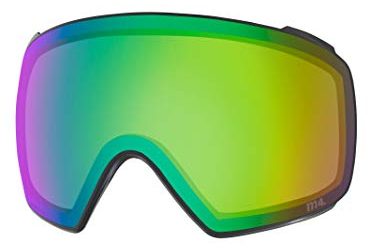
The M6 is the warm-weather answer to a cold problem: wind finding the gap between goggle and face mask. Anon’s MFI system clips a thermal face mask to the bottom of the frame with magnets, sealing the whole lower face so no cold air sneaks in at speed. The cylindrical lens sits close to the face in a low-profile frame, and the Magna-Tech magnets make lens swaps a one-handed job even in thick mittens. Two Perceive lenses come in the box, and the frame fits medium to large faces, which suits most older riders. The MFI mask is the reason to pick this one over the cheaper Anon models.
Specs
- Magna-Tech magnetic quick lens change system
- MFI magnetic face mask integration, mask included
- Two Perceive lenses included for bright and low light
- Cylindrical lens with a low-profile frame
- 100 percent UV protection
- Over-the-glasses compatible frame
- Spare lens, lens compression case and microfiber bag included
- Medium to large fit
Best for: Riders who feel the cold most on their face and want a sealed mask system.
Watch out for: The M6 fits medium to large faces, so riders with a narrow face should look at the smaller M6S instead. Confirm the listing includes the MFI mask and the bonus lens, since Anon sells the goggle alone in some listings.
Anon Sync

The Sync is the plainest goggle in this guide, and for many older riders that is exactly the point. It does one thing well: it sits comfortably over prescription glasses without fuss. The frame geometry is built around glasses wearers, with room at the temples and a seal that does not press the glasses arms into your head. The lens is linearly polarized, which cuts glare off icy patches and wet snow, and the magnetic swap changes lenses without tools. A bonus lens and the MFI face mask come in the box, so the kit is complete on day one.
Specs
- Magnetic lens change system with a full-rim frame
- Linearly polarized lens for glare reduction
- Bonus lens included for lower light
- MFI face mask included
- Over-the-glasses optimized frame geometry
- Scratch-resistant lens coating
- Microfiber goggle bag included
Best for: Glasses wearers who want the simplest, most comfortable fit.
Watch out for: The Sync uses a cylindrical lens rather than a toric one, so the peripheral view is narrower than the toric picks in this guide. Confirm the listing is the Sync and not the M4 or M6, which share the same MFI mask system.
Dragon NFX2

The NFX2 is the easiest goggle here to operate with cold, stiff fingers, because its SwiftLock system works with a single lever instead of magnets that need precise alignment. Pull the lever, the lens pops free, and the new one clicks home. The frameless design opens the peripheral view wide, and the Lumalens optics sharpen contrast on flat days so icy patches show up before your edges find them. A bonus low-light lens ships in the box, the triple-layer foam wicks moisture through long days, and the armored venting lets you clear snow from the vents with a gloved hand without tearing the foam.
Specs
- SwiftLock lens change system with a one-sided release lever
- Frameless design with a premium injected cylindrical lens
- Lumalens optics for color optimization and depth perception
- Bonus low-light lens included
- Super anti-fog coating on the lens
- Armored venting for snow clearing
- Triple-layer face foam with hypoallergenic microfleece lining
- Medium fit
Best for: Riders with cold or stiff fingers who want the simplest lens swap.
Watch out for: Dragon sells the NFX2 in many colorways under one family listing, so confirm the frame and lens tint in the selector before checkout. The NFX MAG OTG is a different, newer model, so check the model name on the listing.
OutdoorMaster Heron

The Heron is the value pick, and it earns the spot honestly: two lenses, a magnetic swap, a toric lens and an over-glasses frame for a fraction of the price of the premium picks. The toric lens curves in two directions to match the eye, which cuts distortion at the edges and widens the view without a premium badge. The MagKlick system uses ten magnets to hold the lens, and the kit includes a yellow low-light lens for flat days, a hard case and a pouch. The triple foam seals well over glasses, and the extra-long strap fits over any helmet.
Specs
- Frameless toric lens with a wide field of view
- MagKlick magnetic interchangeable lens system with ten magnets
- Two lenses included, primary plus yellow low-light lens
- Over-the-glasses frame with triple-layer foam
- 100 percent UV400 protection
- Anti-fog coating on the lens
- Extra-long adjustable strap for helmet compatibility
- Hard case and carrying pouch included
- Lens measures 8.27 inches wide by 3.74 inches tall
Best for: Riders who want two lenses and a magnetic swap at the lowest cost in this guide.
Watch out for: Some Heron listings sell the goggle alone, so confirm the yellow low-light lens is included before checkout. The Heron is a large-fit frame, so riders with a narrow face may find the seal loose at the cheeks.
Which One Fits Your Situation
You Wear Prescription Glasses
Pick the Anon Sync first. Its frame is built around glasses, with temple cutouts and a seal that does not press the arms into your head, and the polarized lens cuts glare off ice. The OutdoorMaster Heron is the budget alternative with the same over-glasses depth and triple foam, though its large frame can feel loose on a narrow face. Whichever you choose, try it on with your actual riding glasses and your helmet before the first run.
Your Light Changes by the Hour
Pick the Smith 4D MAG. The magnetic swap with locking levers is the fastest here, and the two ChromaPop lenses in the box cover bright sun and flat light without a separate purchase. The Dragon NFX2 is the runner-up if your fingers are stiff, since its single-lever SwiftLock needs no precise alignment. Carry the spare lens in a hard case in your jacket pocket, not loose in a pack.
You Ride Mostly on Grey, Flat-Light Days
Pick the Dragon NFX2 or the Anon M6. The NFX2’s Lumalens and the M6’s Perceive lenses both sharpen contrast when the sky goes white, and both ship with a low-light lens in the box. Use the rose or amber lens on overcast days and save the dark mirror for bluebird mornings. If the slope looks flat and featureless, slow down and follow the fall line rather than guessing at bumps you cannot see.
You Want One Goggle and No Spare Lens to Carry
Pick the OutdoorMaster Heron and leave the second lens at home on bluebird days, or pick the Anon Sync, whose polarized lens handles a wider range of light on its own. A single-lens setup only works if the lens suits the day, so check the forecast and the light before you leave the lodge. A photochromic lens that darkens in sun is the only single lens that truly covers both ends of the day.
Common Mistakes
- Buying a goggle that is not OTG and then forcing prescription glasses under it, which breaks the seal and fogs the lens within minutes.
- Choosing a size variant of a delivered model, such as the Oakley Flight Deck L, which is the large size of the Flight Deck M already picked in the men’s guide, not a different goggle.
- Wiping the inside of the lens with a glove or sleeve, which strips the anti-fog coating and guarantees fog for the rest of the season.
- Pushing the goggles up onto a warm forehead between runs, where sweat fogs the inner lens before the next descent.
- Buying a single-lens goggle for a week of variable weather, then riding blind on flat-light afternoons because the spare lens is still at home.
Frequently Asked Questions
Do I need an OTG goggle if I wear glasses?
Yes, unless you ride with contact lenses. A standard frame presses the glasses arms into your temples and leaves gaps at the sides, which lets cold air in and fogs the lens. An OTG frame has temple cutouts and extra depth inside, so your glasses sit naturally and the foam seals all the way around. Try the goggles on with your riding glasses and your helmet before the first run.
Are magnetic lenses safe at speed?
Yes, when the system includes a lock. The Smith 4D MAG pairs magnets with locking levers, the Anon models use magnets rated to hold through crashes, and the Dragon NFX2 adds a mechanical lever on top of its magnetic-free SwiftLock. A bare magnetic lens with no lock can pop off in a hard fall, so check for a locking mechanism on the listing before you buy.
Is a photochromic lens enough for storm days?
A photochromic lens that darkens in sun and clears in cloud covers most days, but it cannot match a dedicated low-light lens on a truly flat, snowy afternoon. The rose or amber spare lens in the Smith, Anon and Dragon kits lifts contrast far more than any single lens that tries to do both jobs. If you ride mostly in storms, carry the spare lens.
Will these goggles fit my helmet?
All five picks sit flush against a standard ski or snowboard helmet, with an extra-long strap and silicone backing to stop slipping. The fit still depends on your helmet: try the goggle and helmet together and look for a gap at the forehead, which lets cold air in and fogs the lens. If the gap will not close, the shapes do not match, and a different pairing is the fix.
FAQ
Do I need an OTG goggle if I wear glasses?
Are magnetic lenses safe at speed?
Is a photochromic lens enough for storm days?
Will these goggles fit my helmet?
More from Amazon
Programs that pair well with the guide above. Offers and eligibility are set by Amazon and may change.
Free shipping on eligible items, Prime Video and more. Eligible new members can start with a free trial.
Start a Prime free trialAudiobooks and podcasts to listen to on the go. Eligible new members can start with a free trial.
Try Audible freeAd-free music streaming. Eligible new subscribers can start with a free trial.
Try Music Unlimited freeA free business account with business pricing and bulk-buying tools for work, shop or home office.
Create a business accountAs an Amazon Associate we earn from qualifying purchases.
Write Your Review
No reviews yet. Be the first to share your experience!