
Key takeaways
- Compare best avalanche airbag backpacks for backcountry skiing, from electronic Alpride E2 packs to canister systems, and pick the right volume and fit.
An avalanche airbag backpack is one of the most consequential pieces of backcountry ski gear you can carry. When the airbag inflates, it increases your volume in moving snow, keeping you closer to the surface and reducing burial depth. It is not a guarantee of survival, and it never replaces avalanche education, careful route choice, or a transceiver, shovel, and probe. For skiers who travel in avalanche terrain, it adds protection no other pack can offer.
Choosing is harder than it looks. Electronic packs use a fan or compressor powered by a rechargeable supercapacitor or battery, while canister packs rely on compressed gas. Volumes run from compact 18-litre day packs to 35-litre multi-day haulers, and some packs ship without the airbag system at all. This guide compares five airbag options, four backpacks and one vest-style carrier, and helps you match volume, weight, and inflation type to the way you ski.
As an Amazon Associate, we earn from qualifying purchases.
Quick Answer
For most backcountry skiers, the Osprey Soelden Pro 32 E2 is the strongest all-round choice, with its electronic Alpride E2 system included, 32 litres of storage, and an avalanche-tool pocket. Skiers who want maximum volume should look at the Mammut Pro 35, while the Black Diamond JetForce Pro 25 suits those who value practice deployments. Always pair any airbag pack with avalanche training and a transceiver, shovel, and probe.
The Best Avalanche Airbag Backpacks
1. Osprey Soelden Pro 32 E2 — Best Electronic All-Rounder

The Osprey Soelden Pro 32 E2 is a 32-litre pack for men who ski or snowboard in the backcountry, and it arrives with the Alpride E2 electronic airbag already installed. That matters: several rival packs are sold as airbag-ready shells, so the Osprey saves a separate purchase. The E2 runs on a supercapacitor charged by USB, so you can deploy it repeatedly for practice without refills, and supercapacitor power holds up well in the cold. A large front J-zip opens to a dedicated avalanche-tool pocket with sleeves for a shovel handle and probe. The main compartment opens with a U-zip, and a GPS and radio pocket keeps communications gear handy. Skis ride A-frame or diagonal, a snowboard rides vertically, and a helmet can be carried at the front or top.
Specs
- Capacity: 32 litres
- Airbag system: Alpride E2 electronic, included
- Airbag power: rechargeable supercapacitor, USB charging
- Tool pocket: front J-zip with shovel handle and probe sleeves
- Carry: A-frame or diagonal ski carry, vertical snowboard carry, front or top helmet carry
- Fabric: Nanofly 100D recycled Robic nylon with UHMWPE grid
- Listed weight: 6.4 lb
- Tier: premium
2. Mammut Pro 35 Removable Airbag 3.0 — Best for Big Days

The Mammut Pro 35 is the largest pack in this guide, and the natural pick for long tours, hut trips, and days when a spare layer, extra food, and a full repair kit all need to come along. Its 35-litre main compartment is built from 420D recycled nylon oxford HD, a fabric chosen for abrasion resistance. Inside, the pack uses the Mammut Removable Airbag System 3.0, a compressed-air system with a 150-litre airbag that inflates in about three to five seconds. The system is removable, so it can be transferred between compatible Mammut packs. The compressed-air cartridge is sold separately, so budget for it on top of the pack, and a canister system needs a refill or a fresh cartridge after every deployment, unlike an electronic system that can be recharged and fired again.
Specs
- Capacity: 35 litres
- Airbag system: Mammut Removable Airbag System 3.0, compressed air
- Airbag volume: 150 litres
- Inflation time: about three to five seconds
- Cartridge: sold separately
- System: removable and transferable between compatible Mammut packs
- Fabric: 420D recycled nylon oxford HD
- Tier: mid-range
3. Black Diamond JetForce Pro 25 — Best for Practice Deployments
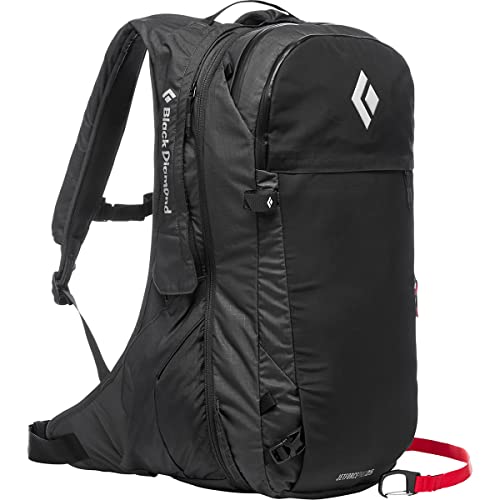
The Black Diamond JetForce Pro 25 is built around a rechargeable fan system rather than a gas canister. A lithium-ion battery powers a jet fan that draws in surrounding air and inflates a 200-litre airbag in about three and a half seconds. After three minutes the bag deflates automatically, leaving an air pocket that can aid extraction. Because there is no canister to refill, you can deploy the pack several times on a single charge, which makes it the easiest pack here to practise with. The pack is modular, with booster packs in 10, 25, and 35-litre sizes sharing the same base unit. A dedicated avalanche-tool pocket keeps shovel and probe organised, and the listed weight is about 6 lb 7 oz in the 25-litre configuration. The trade-off is weight and charging: the fan and battery add bulk, and the pack needs a full charge before a trip.
Specs
- Capacity: 25 litres
- Airbag system: Black Diamond JetForce Pro fan, rechargeable lithium-ion battery
- Airbag volume: 200 litres
- Inflation time: about three and a half seconds
- Deployments: several per charge, with automatic deflation after three minutes
- Updates: Bluetooth firmware updates through the Pieps app
- Modularity: booster packs in 10, 25, and 35-litre sizes
- Tier: premium
4. Dakine Poacher R.A.S. 18L — Best Compact Airbag-Ready Pack

The Dakine Poacher R.A.S. 18L is the most compact option in this guide, and it needs to be understood clearly before you buy it. This is an airbag-ready backpack, not a complete airbag backpack: it is built to accept the Mammut Removable Airbag System 3.0, but that system is sold separately. Bought alone, it is a well-made 18-litre backpack with an empty airbag compartment and no avalanche airbag protection, so budget for the Mammut system before counting it as safety gear. Once the system is fitted, the Poacher becomes a light, nimble option for short tours and resort sidecountry laps. Its appeal is a compact footprint with a proven Mammut system, but pack plus system plus cartridge adds up, so compare the full package with a complete pack before deciding.
Specs
- Capacity: 18 litres
- Airbag system: compatible with Mammut Removable Airbag System 3.0, sold separately
- Airbag included: no, the pack ships with an empty airbag compartment
- Closure: roll-top airbag closure
- Carry: ski and snowboard carry
- Best for: short tours and sidecountry laps
- Tier: budget for the pack alone, before adding the airbag system
5. BCA Float MtnPro Vest 2.0 — Best Vest-Style Option

The BCA Float MtnPro Vest 2.0 is the one product in this guide that is not a backpack, and it earns its place for riders who prefer a vest. Built mainly for snowmobilers, it wraps the airbag system around the torso instead of hanging it from the shoulders, which spreads the load across the chest and back. Integrated pockets hold a transceiver and a radio, so the core safety tools ride in fixed positions. A vest suits a different style of riding from a ski touring pack. With no large main compartment, it works best for machine-assisted days and shorter missions where the sled carries the bulky gear. Skiers touring on foot should choose one of the backpacks above.
Specs
- Format: vest, not a backpack
- Airbag: integrated avalanche airbag
- Storage: integrated pockets for transceiver and radio
- Fit: vest-style torso fit that spreads load across chest and back
- Best for: snowmobile-assisted backcountry days
- Tier: premium
How to Choose an Avalanche Airbag Backpack
Start with the inflation system: it decides how you practise and how you travel. Electronic systems, such as the Alpride E2 in the Osprey and the JetForce fan in the Black Diamond, recharge by USB and can be deployed repeatedly for training without refills. Canister systems, such as the Mammut Removable Airbag System 3.0, are mechanically simple and dependable, but each deployment consumes a cartridge that must be refilled or replaced.
Match volume to your typical day: compact packs around 18 litres suit short laps and sidecountry, 25 to 32 litres cover most full-day tours, and 35 litres and above suit hut trips and multi-day objectives. Check the avalanche-tool pocket first: a dedicated front pocket with shovel and probe sleeves is far quicker in an emergency than a main compartment stuffed with layers. Fit matters as much as features. Try the pack loaded, with the system fitted, and check that the trigger handle falls naturally to hand.
Who Should Skip an Avalanche Airbag Backpack
An airbag pack is not for every skier. If you only ski inside resort boundaries and never cross into uncontrolled terrain, the weight, bulk, and upkeep of an airbag system buy you little, and a good touring pack will serve you better. The same applies if you will not take an avalanche course and practise with your transceiver, shovel, and probe. Skiers on a tight budget should also think carefully: a complete electronic pack is a major purchase, and a canister pack still needs cartridges and servicing. If buying an airbag pack means skipping the avalanche course or the transceiver, spend on education and the rescue trio first.
Frequently Asked Questions
Do avalanche airbag backpacks guarantee survival?
No. An airbag improves your odds by keeping you closer to the surface of moving snow and reducing burial depth, but it cannot prevent an avalanche or protect against trauma. Avalanche education, careful terrain decisions, and a transceiver, shovel, and probe remain the foundation of backcountry safety.
Can I fly with an avalanche airbag backpack?
Electronic systems are the easiest to travel with, since they use a rechargeable battery or supercapacitor rather than a pressurised canister. Canister systems need the cartridge removed or declared, and airline rules vary.
How many times can I deploy an electronic airbag?
Electronic systems can be deployed repeatedly for practice. The Black Diamond JetForce Pro allows several deployments on a single charge, and the Alpride E2 supercapacitor system can be recharged by USB and fired again without refills. Canister systems need a fresh cartridge or a refill after each deployment.
Does the Dakine Poacher R.A.S. 18L include the airbag?
No. The Poacher is an airbag-ready backpack built for the Mammut Removable Airbag System 3.0, which is sold separately. Without that system fitted, the pack has an empty airbag compartment and provides no avalanche airbag protection. Add the cost of the system and a cartridge when you compare it with complete packs.
Final Verdict
For most backcountry skiers, the Osprey Soelden Pro 32 E2 is the pick: a complete electronic system included, a sensible 32-litre volume, and a properly organised tool pocket. The Mammut Pro 35 is the choice for the biggest days, with 35 litres and a simple canister system, while the Black Diamond JetForce Pro 25 is the best option for skiers who want to practise deployments often. The Dakine Poacher R.A.S. 18L is a smart compact choice only once the Mammut system is added, and the BCA vest suits riders who prefer that format. Whichever you choose, pair it with training and a transceiver, shovel, and probe.
FAQ
Do avalanche airbag backpacks guarantee survival?
Can I fly with an avalanche airbag backpack?
How many times can I deploy an electronic airbag?
Does the Dakine Poacher R.A.S. 18L include the airbag?
More from Amazon
Programs that pair well with the guide above. Offers and eligibility are set by Amazon and may change.
Free shipping on eligible items, Prime Video and more. Eligible new members can start with a free trial.
Start a Prime free trialAudiobooks and podcasts to listen to on the go. Eligible new members can start with a free trial.
Try Audible freeAd-free music streaming. Eligible new subscribers can start with a free trial.
Try Music Unlimited freeA free business account with business pricing and bulk-buying tools for work, shop or home office.
Create a business accountAs an Amazon Associate we earn from qualifying purchases.


Write Your Review
No reviews yet. Be the first to share your experience!