
Key takeaways
- Find the best ice fishing heaters for small and large shelters, with propane radiant options, safety features, fuel choices, and sizing guidance.
A cold shelter turns a good day on the ice into a short one. Hands stiffen, holes freeze over, and sitting still becomes hard work. A portable heater made for an ice-fishing shelter changes that, warming the air around the holes and letting anglers stay out longer in comfort.
The best ice fishing heaters are portable propane radiant heaters sized to the shelter. For most anglers, a mid-output heater with two heat settings, an oxygen-depletion sensor, and tip-over shutoff is the right place to begin. Small shelters need less output, while large hub shelters need more. This guide covers five heaters for those jobs, explains how to size one, and sets out the safety steps for every trip.
As an Amazon Associate, we earn from qualifying purchases.
Table of Contents
- Quick Answer
- How to Choose an Ice Fishing Heater
- Safety First: Ventilation and Carbon Monoxide
- 1. Mr. Heater Portable Buddy
- 2. Mr. Heater Big Buddy
- 3. Mr. Heater Little Buddy
- 4. Heat Hog 9,000 BTU Portable Propane Heater
- 5. Mr. Heater Buddy Flex
- Which Heater Fits Your Shelter
- Frequently Asked Questions
- Conclusion
- Product and ASIN Reference
Quick Answer
For most ice anglers, the Mr. Heater Portable Buddy is the best all-round choice. It offers two heat settings, covers shelters up to 225 square feet, and runs on a single 1 lb propane cylinder, with a larger tank connection possible through a compatible hose and filter. Anglers with a large hub shelter should look at the Big Buddy, which adds a third, higher setting and covers up to 450 square feet. Solo anglers in a small flip-over shelter will find the Little Buddy enough, while the Heat Hog suits anglers who want to aim the heat, and the Buddy Flex suits those who want heat in all directions.
How to Choose an Ice Fishing Heater
Begin with shelter size. A heater rated for far more space than the shelter will cycle between too hot and off, while one rated for far less will run at full output all day and still leave cold corners. Manufacturers list a heated area for each model. A one-person flip-over shelter is a small job, a two- or three-person hub shelter is a medium job, and a four-person hub shelter or permanent shack needs the highest output in this guide.
Heat settings matter as much as maximum output. A heater with two or three settings can run low once the shelter warms up, which stretches fuel and keeps the temperature steady. A single-setting heater is simpler, but it cannot be turned down on a mild day or up when the wind picks up.
Fuel supply is the next decision. Most heaters here run on disposable 1 lb propane cylinders, and several can also connect to a larger refillable tank with a compatible hose. A 1 lb cylinder is easy to carry and swap on the ice, but it runs out faster at high output. A larger tank lasts longer, but it adds weight and takes up floor space.
Weight and footprint matter inside a shelter, where floor space is limited. A compact heater that sits low and stable leaves more room to fish, so check the listed dimensions before buying.
Look for an oxygen-depletion sensor, a tip-over switch, and a sturdy guard over the hot face. These features do not replace ventilation and a carbon-monoxide alarm.
Safety First: Ventilation and Carbon Monoxide
Every fuel-burning heater needs fresh air. Manufacturer guidance calls for ventilation whenever these heaters run in an enclosed space, including insulated shelters. Open a vent or leave a window or door partly open, following the instructions supplied with the heater and the shelter. Never seal a shelter tight around a running propane heater, and never block the vents to hold heat in.
Carbon monoxide is colorless and odorless, and it can build up without warning in an enclosed shelter. Use a battery-powered carbon-monoxide alarm inside the shelter whenever a fuel-burning heater is running, and check that it works before heading out. If the alarm sounds, or if anyone feels headache, dizziness, nausea, or unusual tiredness, turn the heater off, get fresh air at once, and do not go back inside until the shelter has aired out. Do not sleep in a shelter with a fuel-burning heater running, and do not leave one running unattended.
Keep the heater clear of anything that can burn, including shelter fabric, clothing, gloves, and spare cylinders. Place it on a flat, stable surface, away from the holes and walkways, and let it cool fully before packing it away. Store cylinders upright, outside the shelter when not in use, and check connections for damage before each trip. If gas can be smelled, turn the heater off, do not light it, and ventilate the shelter.
1. Mr. Heater Portable Buddy
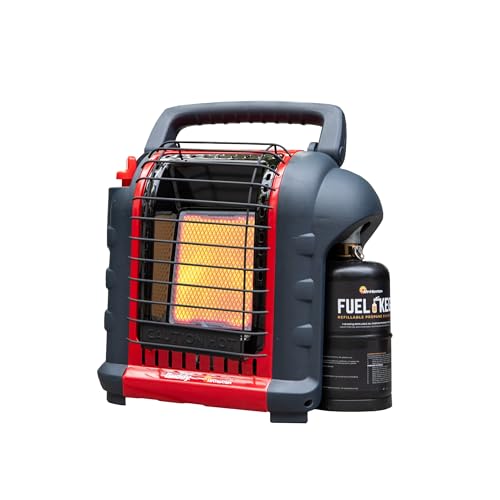
The Portable Buddy is the reference point for this category, matching the most common ice-fishing job. It produces 4,000 or 9,000 BTU per hour of radiant heat, covering shelters up to 225 square feet. That fits most two- and three-person hub shelters and flip-over shelters, with the low setting for mild days and the high setting for cold mornings and wind.
It runs on a single 1 lb propane cylinder with a swivel regulator, and it can connect to a larger tank with a compatible hose and filter. Run time is listed at about 6 hours on low and about 3 hours on high, so a full day usually needs spare cylinders or a larger tank. The piezo igniter lights it without matches, and the oxygen-depletion sensor and tip-over shutoff cover the two safety features that matter most inside a shelter.
Specs
| Feature | Detail |
|---|---|
| Heat output | 4,000 or 9,000 BTU per hour |
| Heated area | Up to 225 square feet |
| Fuel | 1 lb propane cylinder; larger tank with compatible hose and filter |
| Run time on 1 lb cylinder | About 6 hours on low; about 3 hours on high |
| Ignition | Piezo igniter |
| Safety features | Oxygen-depletion sensor; tip-over shutoff |
2. Mr. Heater Big Buddy

The Big Buddy is the choice for large shelters. It offers three heat settings at 4,000, 9,000, and 18,000 BTU per hour, and it is rated to heat up to 450 square feet. That covers four-person hub shelters, large insulated shelters, and permanent shacks that a smaller heater would struggle to warm. On mild days it can run on the low setting, which keeps fuel use down.
It can run on one or two 1 lb propane cylinders, and it can connect to a larger bulk tank. Two cylinders extend run time, and a bulk tank suits a full day in a large shelter. The listing notes low-oxygen safety shutoff and tip-over protection. This version has no built-in fan, so it relies on radiant heat and natural air movement, and it needs a clear, flat spot on the shelter floor.
Specs
| Feature | Detail |
|---|---|
| Heat output | 4,000, 9,000, or 18,000 BTU per hour |
| Heated area | Up to 450 square feet |
| Fuel | One or two 1 lb propane cylinders; larger bulk tank |
| Safety features | Low-oxygen safety shutoff; tip-over protection |
| Built-in fan | Not included in this version |
3. Mr. Heater Little Buddy

The Little Buddy is the smallest heater in this guide, and it suits the smallest shelters. It produces a single 3,800 BTU per hour of radiant heat and is rated for spaces up to 95 square feet. That is enough for a one-person flip-over shelter or a small two-person shelter on a mild day, and it suits a solo angler who wants light gear and simple operation.
It runs on a 1 lb propane cylinder only, with a listed run time of about 5.6 hours. Its listed weight is 5.85 lb, making it the lightest heater here and the easiest to carry on foot. The single heat setting means there is nothing to adjust once it is lit, and the heater cannot be turned down if the shelter gets warm. The listing notes an oxygen-depletion system and a tip-over safety switch.
Specs
| Feature | Detail |
|---|---|
| Heat output | 3,800 BTU per hour, single setting |
| Heated area | Up to 95 square feet |
| Fuel | 1 lb propane cylinder only |
| Run time on 1 lb cylinder | About 5.6 hours |
| Safety features | Oxygen-depletion system; tip-over safety switch |
| Weight | 5.85 lb |
4. Heat Hog 9,000 BTU Portable Propane Heater

The Heat Hog 9,000 BTU heater is the tilting option in this group. It produces up to 9,000 BTU per hour of radiant heat and is rated for spaces up to 225 square feet, matching the Portable Buddy for coverage. Its tiltable head lets the angler aim the heat toward hands, knees, or the holes.
It runs on a 1 lb propane cylinder or a larger tank with an accessory hose, and it needs no electricity. The manufacturer lists a rugged safety guard, a tip-over switch, and an oxygen-depletion sensor. Check the listing for the current heat settings before buying.
Specs
| Feature | Detail |
|---|---|
| Heat output | Up to 9,000 BTU per hour |
| Heated area | Up to 225 square feet |
| Fuel | 1 lb propane cylinder; larger tank with accessory hose |
| Safety features | Oxygen-depletion sensor; tip-over switch; rugged safety guard |
| Heat direction | Tiltable head |
| Electricity needed | No |
| Weight | Not stated |
| Dimensions | Not stated |
5. Mr. Heater Buddy Flex

The Buddy Flex takes a different approach to spreading heat. It produces up to 11,000 BTU per hour of omni-directional radiant heat, which warms in all directions at once rather than in a single beam. That suits a shelter where anglers sit around the heater, or where holes are spread across the floor. It is rated to heat up to about 275 square feet, between the Portable Buddy and the Big Buddy for coverage.
This listing is a bundle that pairs the heater with a 10-foot propane hose assembly, which suits connection to a larger tank. The heater also runs on 1 lb propane cylinders. Its listed weight is 11.7 lb, and its listed dimensions are 13.5 inches deep by 9 inches wide by 14.25 inches high. It gives adjustable heat settings up to its 11,000 BTU maximum, so it can run lower once the shelter warms up.
Specs
| Feature | Detail |
|---|---|
| Heat output | Up to 11,000 BTU per hour |
| Heated area | Up to about 275 square feet |
| Fuel | Propane; 1 lb cylinder or larger tank |
| Hose | 10-foot propane hose assembly included in this bundle listing |
| Heat pattern | Omni-directional radiant heat |
| Weight | 11.7 lb |
| Dimensions | 13.5 x 9 x 14.25 inches |
Which Heater Fits Your Shelter
Match the heater to the shelter first. A solo angler in a one-person flip-over shelter needs the Little Buddy and nothing more. Its low output, light weight, and long run time on a single cylinder fit short sessions and long walks onto the ice alike.
A two- or three-person hub shelter is the middle of the range, and that is where most anglers land. The Portable Buddy and the Heat Hog both cover up to 225 square feet, and the choice between them comes down to heat direction. Choose the Portable Buddy for two heat settings. Choose the Heat Hog when aiming the heat at one spot matters more than having a low setting.
A group in a medium to large hub shelter should consider the Buddy Flex, with 11,000 BTU per hour and omni-directional heat for anglers sitting around it. A four-person hub shelter or a permanent shack needs the Big Buddy, with its 18,000 BTU top setting and 450 square foot rating.
Frequently Asked Questions
What size heater do I need for an ice fishing shelter?
Match the heater rating to the shelter size. A heater rated up to 95 square feet suits a one-person shelter, one rated up to 225 square feet suits most two- and three-person shelters, and one rated up to 450 square feet suits a large hub shelter or a permanent shack.
Can I use a propane heater inside an ice fishing shelter?
A portable propane heater made for indoor use can be used inside a shelter only with ventilation, a working carbon-monoxide alarm, and the safety features in this guide, including an oxygen-depletion sensor and tip-over shutoff. Follow the heater and shelter instructions, and never sleep with a fuel-burning heater running.
How long will a 1 lb propane cylinder last in a shelter heater?
Run time depends on the heat setting. The Portable Buddy is listed at about 6 hours on low and about 3 hours on high from a 1 lb cylinder, while the Little Buddy is listed at about 5.6 hours. Carry spares or a larger tank for a full day.
Should I choose a radiant heater or a catalytic heater for ice fishing?
Radiant propane heaters warm people and surfaces directly and suit shelters with holes open to the ice. Catalytic heaters warm with a flameless chemical reaction and use fuel slowly, but they warm up more slowly and need protection for the catalytic pad. For most ice anglers, a radiant heater with adjustable output is the simpler choice.
Conclusion
The best ice fishing heater is the one that matches the shelter, carries safely, and runs with ventilation and a carbon-monoxide alarm every time. For most anglers, that is the Portable Buddy, with two settings and coverage up to 225 square feet. Large shelters call for the Big Buddy, solo shelters call for the Little Buddy, directional heat calls for the Heat Hog, and heat shared around a group calls for the Buddy Flex. Choose by shelter size first, and put safety ahead of warmth on every trip.
FAQ
What size heater do I need for an ice fishing shelter?
Can I use a propane heater inside an ice fishing shelter?
How long will a 1 lb propane cylinder last in a shelter heater?
Should I choose a radiant heater or a catalytic heater for ice fishing?
More from Amazon
Programs that pair well with the guide above. Offers and eligibility are set by Amazon and may change.
Free shipping on eligible items, Prime Video and more. Eligible new members can start with a free trial.
Start a Prime free trialAudiobooks and podcasts to listen to on the go. Eligible new members can start with a free trial.
Try Audible freeAd-free music streaming. Eligible new subscribers can start with a free trial.
Try Music Unlimited freeA free business account with business pricing and bulk-buying tools for work, shop or home office.
Create a business accountAs an Amazon Associate we earn from qualifying purchases.


Write Your Review
No reviews yet. Be the first to share your experience!