
Key takeaways
- Compare the best ice fishing jackets for men: float-assist warmth, waterproof shells, and honest fit notes for long, cold days on hard water.
An ice fishing jacket has two jobs that pull in opposite directions. It must keep you warm while you sit still over a hole in wind that never lets up, and it must let you move, drill, and haul gear without turning into a sweat box. The jackets in this guide all add a third job: built-in flotation assistance, so a breakthrough buys you time to get out. That feature is the dividing line here, and it is also the feature most often misunderstood.
The five jackets below are all sold separately on Amazon US as men’s jackets, not as part of a matched suit, and each one carries flotation-assist material in the jacket itself. They cover the coldest stationary days, active hole-hopping, hard-wearing use, and a lower-cost way into a float kit. Every figure comes from the listing or the maker’s own published specs, and where records disagree, the article says so plainly.
Quick Picks
As an Amazon Associate we earn from qualifying purchases.
| Product | Best for | Key spec from title |
|---|---|---|
| Striker Ice Climate Jacket | Coldest stationary days | 3-in-1 shell with 60g PrimaLoft liner |
| Striker Predator Jacket | Active hole-hopping | 100g Thermadex with cross-flow vents |
| Striker Hardwater Jacket | Heavy-duty warmth | 600D Endura shell with 150g Thermadex |
| Eskimo Roughneck Jacket | Hard-wearing use | 600D DuraDry shell with Uplyft flotation |
| Piscifun Ice Fishing Jacket | A lower-cost float kit | Flotation assist with 7 pockets and whistle |
How to Choose
Float Assist Is Not a Life Jacket
Flotation assistance is extra buoyancy built into the jacket, usually closed-cell foam in the chest, back, and collar. It can keep an average adult afloat for a limited time after a breakthrough, but it is not a USCG-approved personal flotation device, and it will not keep an unconscious person face-up. Check that the maker states flotation material is built into the jacket itself, because a jacket from a floating suit does not always float on its own. Also look for a drainage system that lets trapped water escape instead of weighing the jacket down during self-rescue, and treat every buoyancy figure as a maker claim, not a certified rating.
Match Insulation to How You Fish
The warmest jacket is not automatically the best choice, because warmth and movement work against each other on the ice. A heavy, fully insulated jacket suits a day spent sitting in a shelter watching tip-up flags, while a lighter jacket with vents suits a day spent drilling hole after hole and hauling a sled between spots. Insulation weights cannot be compared directly across materials: a removable liner, a fixed layer of Thermadex, and a sherpa fleece lining all warm you in different ways. If your day shifts between long sits and hard movement, a removable liner gives the most flexibility, since you can shed it when the sun comes out and zip it back in for the coldest hours.
Read the Waterproof and Breathability Figures
Waterproof and breathability figures are usually printed together, such as 5,000mm and 5,000g, but they measure different things. The millimetre figure shows how much water pressure the fabric resists before leaking, while the gram figure shows how much moisture vapor passes through a square metre of fabric in a day. Waterproofing matters most in wet snow, sleet, blowing slush, and late-ice thaws, while breathability matters most when you drill repeatedly or walk long distances with a loaded sled. Figures from different brands are not always directly comparable, so also look for fully taped seams, protected zippers, and a durable water-repellent finish before trusting a number on its own.
Fit, Length, and Layering Room
An ice fishing jacket must fit over a base layer, a mid-layer, and the top of your bibs, so the right size is often one up from your everyday jacket size. Check the size chart against your chest measurement with layers on, not against the size you wear to the office. Length matters too: a short torso leaves your lower back exposed when you bend over a hole, and a long body can bunch up when you sit on a bucket. Tall sizes add length in the body and sleeves, which helps taller anglers but does nothing for a shorter angler who needs a roomier chest. Try the jacket on with the layers you fish in before the season opens.
The 5 Best Options
Striker Ice Climate Jacket

The Climate is the warmest jacket in this guide and the most versatile, thanks to a 3-in-1 design that pairs a waterproof shell with a removable Adapt insulated jacket. Wear the shell alone on a mild, windy afternoon, zip the liner in for a pre-dawn tip-up check, or wear the liner on its own off the ice. The magnetic storm flap over the main zipper blocks wind without fiddly snaps, and the fleece-lined collar, hood, and hand pockets take the edge off a long sit. It is also the bulkiest jacket here, so hauling a sled or drilling in it takes more effort than in a lighter shell.
Specs
- Hydrapore waterproof 5,000mm and breathable 5,000g
- Removable Adapt insulated liner with 60g PrimaLoft Black insulation
- 150g Sureflote flotation assistance
- 300D polyester shell with DWR finish
- Fully taped seams and waterproof zippers
- Magnetic center front storm flap
- Line Cutterz zipper pull for cutting line
- Fleece-lined collar, hood, and hand pockets
- Reflective elements throughout
- Pit zips for ventilation
- Sizes S to 5XL; tall sizes add 2 inches in body and sleeve length
Best for: Anglers who sit still in deep cold and want one jacket that covers the whole season.
Watch out for: Insulation figures disagree across records: one older source prints 175g Thermadex for the Climate, while current maker material describes the removable 60g PrimaLoft Black liner. Confirm the liner on the exact listing. The jacket runs small, so size up, and the maker publishes no confirmed flotation duration for the jacket worn without its matching bibs.
Striker Predator Jacket
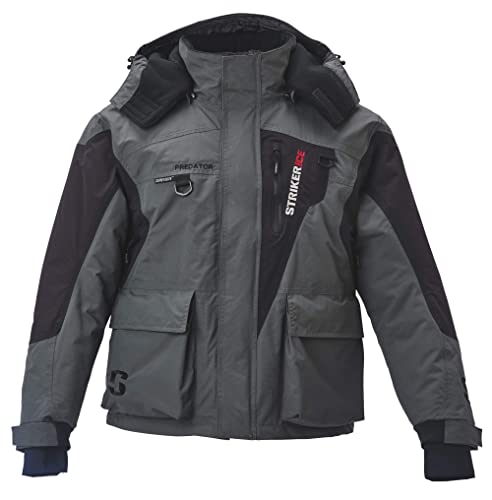
The Predator is the jacket for anglers who move. Its cross-flow venting system dumps heat while you drill and haul gear, and its lighter 100g Thermadex insulation keeps you from sweating through a base layer by the fourth hole. The 320D Nylon Tussor shell is thick and durable, and the two-point adjustable hood stays out of your line of sight while you work an auger. It is noticeably less warm than the Climate when you stop moving, so it is not the pick for a full day parked in a shelter. Think of it as the mobility jacket in the Striker line, built for run-and-gun days.
Specs
- 320D Nylon Tussor shell
- 100g Thermadex insulation
- Hydrapore waterproof 5,000mm and breathable 5,000g
- Sureflote flotation assistance
- Cross-flow venting system
- Two-point adjustable hood
- Magnetic storm flap closures
- Fully taped seams
- Sizes S to 5XL
Best for: Anglers who drill many holes and move between spots all day.
Watch out for: Sizing reports disagree: one field guide says the Predator runs generous and suggests sizing down, while older owner reports say Striker jackets run small. Confirm the size chart against your layered chest measurement. The listing record for this ASIN was last tracked in August 2022, so confirm a current seller on the exact listing before ordering.
Striker Hardwater Jacket

The Hardwater is the heavy-duty member of the Striker line, built around a rugged 600D Endura outer shell with 320D nylon across the shoulders. Its 150g of Thermadex insulation sits between the Climate and the Predator for warmth, and its Sureflote flotation assist and 360-degree reflective material cover the safety side. This is the jacket to reach for when the forecast is brutal and you expect to kneel, haul, and work in blowing snow. The trade-off is weight and bulk: owner reports call it the heaviest jacket in the Striker range, and it is not the one to wear on a mild day when you plan to move fast.
Specs
- 600D Endura outer shell with 320D nylon across the shoulders
- 150g Thermadex insulation
- Waterproof 5,000mm and breathable 5,000g
- Sureflote flotation assistance
- 360-degree reflective material
- Fully taped seams
- Waterproof zippers
Best for: Anglers who want maximum durability and warmth for the harshest days.
Watch out for: Weight is the weak point: the Hardwater is the heaviest jacket here, and the bulk shows when you drill or haul a sled. The listing record shows a Small in Gray and Black, so confirm the size and color you need in the selector, since each listing covers one size and color.
Eskimo Roughneck Jacket

The Roughneck earns its place on durability. Its DuraDry 600D polyester shell shrugged off repeated contact with ice edges and shelter frames in field use, and the reinforced shoulders and elbows showed no visible wear after hard days. Uplyft breathable flotation assistance is built in, the seams are fully taped, and a sherpa fleece lining traps body heat without a separate liner to manage. It comes in a single color, Forged Iron gray, and there is no Small size, so smaller anglers need to look elsewhere. The main zipper is the fussiest part of the jacket and needs careful alignment, especially with gloves on.
Specs
- DuraDry 600D polyester shell with mechanical stretch
- Uplyft breathable flotation assistance
- Waterproof 5,000mm and breathable 5,000g
- Sherpa fleece insulation
- Reinforced shoulders and elbows
- Fully taped seams
- Windproof with DWR finish
- Sizes M to 5XL; no Small size
- Machine washable
Best for: Anglers who are hard on their gear and want a tough, simple float jacket.
Watch out for: Eskimo publishes no gram figure for the sherpa fleece insulation, so warmth cannot be compared directly with the gram-rated jackets here. The fit runs snug through the shoulders, so size up if you layer heavily, and the zipper needs care to close with gloves on.
Piscifun Ice Fishing Jacket

The Piscifun is the value pick here, and it does not feel stripped down to reach its lower tier. It still includes built-in flotation assistance, fully taped seams, reflective print front and back, a safety whistle, and a mesh hem that drains water instead of holding it against your waist. Seven pockets hold pliers, a spare spool, and a phone without forcing you to dig through one overloaded compartment, and the YKK two-way zipper feels sturdier than the price suggests. The compromise is warmth: its insulation felt noticeably thinner during stationary periods, so choose it for shorter sessions and milder days rather than hours of sitting in deep cold.
Specs
- DWR-coated polyester shell with TPU coating
- Built-in flotation assistance
- Fully taped seams
- YKK two-way main zipper
- Seven pockets
- Reflective print front and back
- Safety whistle on the chest
- Mesh hem for water drainage
- Windproof and breathable shell
Best for: Anglers building a float kit on a budget who fish shorter sessions.
Watch out for: The listing publishes no insulation weight, so warmth is a judgment call, not a number. The hood is fixed, not removable, the cut can feel short through the torso when bending, and sizing runs close, so check the size chart carefully.
Which One Fits Your Situation
Sitting Still in Deep Cold
Pick the Striker Climate. Its removable liner system covers the widest range of conditions in this guide, from a bare shell on a mild afternoon to a fully lined jacket for single-digit mornings with wind. The magnetic storm flap and fleece-lined collar help during long, still sits, and the 150g Sureflote flotation assistance is the strongest published figure here. Accept the bulk, size up, and treat it as the stationary-day jacket.
Hole-Hopping All Day
Pick the Striker Predator. The cross-flow venting system is the feature that matters when you drill eight holes in an hour, because it dumps heat instead of trapping sweat under a heavy shell. Its 100g Thermadex insulation is lighter than the Climate and Hardwater, and the two-point adjustable hood stays clear of your sightline while you work. Pair it with a warm base layer for the coldest stretches.
Hard Wear and Rough Handling
Pick the Eskimo Roughneck. The 600D DuraDry shell and reinforced shoulders and elbows are built for anglers who catch sleeves on shelter frames and haul gear across wind-scoured ice. Uplyft flotation assistance is built in, the seams are fully taped, and the sherpa fleece lining needs no separate liner to manage. Size up if you layer heavily, and accept the single color and the fussy main zipper.
Building a Float Kit on a Budget
Pick the Piscifun. It is the lowest-cost way into a float jacket in this guide, and it still includes the essentials: built-in flotation assistance, taped seams, reflective print, a safety whistle, and a draining mesh hem. Buy it with the matching Piscifun bibs and you have a complete two-piece float kit for far less than a premium matched suit. Plan extra base layers for the coldest days, since its insulation is the thinnest here.
Common Mistakes
- Buying a jacket from a floating suit and assuming it floats on its own. Confirm the maker states flotation material is built into the jacket itself, not only in the matching bibs.
- Comparing insulation weights across different materials. A gram figure for Thermadex, a removable PrimaLoft liner, and a sherpa fleece lining warm you in different ways, so the numbers do not line up directly.
- Sizing to your everyday jacket. An ice fishing jacket must fit over a base layer, a mid-layer, and the top of your bibs, so measure your chest with layers on and check the maker’s chart.
- Treating flotation assistance as a life jacket. These jackets add buoyancy and buy you time, but none is a USCG-approved personal flotation device, and none will keep an unconscious person face-up.
- Skipping the drainage check. A jacket that traps water after a breakthrough gets heavy fast, so look for a mesh hem or drainage channels that let water out during self-rescue.
Frequently Asked Questions
Does a float-assist jacket replace a life jacket?
No. Flotation assistance adds buoyancy and buys you time after a breakthrough, but no jacket in this guide is a USCG-approved personal flotation device. A certified life jacket is built to keep an unconscious person face-up, while a float-assist jacket is not. Wear a certified device when conditions call for one, and treat the jacket’s flotation as a safety margin, not a substitute for safe ice practices.
How warm should my ice fishing jacket be?
Match warmth to how you fish. A heavy, fully insulated jacket suits long sits in a shelter, while a lighter jacket with vents suits active hole-hopping, because drilling and hauling generate heat fast. If your day shifts between sitting and moving, a removable liner gives the most flexibility. Remember that insulation figures across different materials cannot be compared directly, so use the gram figure as a guide, not a guarantee.
Can I wear an ice fishing jacket without the matching bibs?
Yes, every jacket in this guide is sold separately and carries flotation-assist material in the jacket itself. That matters, because some jackets from floating suits only float when worn with their matching bibs. Pair the jacket with any insulated bibs you already own, or buy the matching bibs later. Check that the maker confirms the jacket floats independently before you rely on it alone.
What waterproof rating do I need for ice fishing?
A 5,000mm rating covers most ice fishing conditions, including wet snow, sleet, and slush, and every jacket in this guide meets that figure. Higher ratings help in heavy rain or prolonged exposure, but seams, zippers, and vents matter just as much as the number. Look for fully taped seams, waterproof zippers, and a durable water-repellent finish, and remember that breathability matters too when you work hard on the ice.
FAQ
Does a float-assist jacket replace a life jacket?
How warm should my ice fishing jacket be?
Can I wear an ice fishing jacket without the matching bibs?
What waterproof rating do I need for ice fishing?
More from Amazon
Programs that pair well with the guide above. Offers and eligibility are set by Amazon and may change.
Free shipping on eligible items, Prime Video and more. Eligible new members can start with a free trial.
Start a Prime free trialAudiobooks and podcasts to listen to on the go. Eligible new members can start with a free trial.
Try Audible freeAd-free music streaming. Eligible new subscribers can start with a free trial.
Try Music Unlimited freeA free business account with business pricing and bulk-buying tools for work, shop or home office.
Create a business accountAs an Amazon Associate we earn from qualifying purchases.

Write Your Review
No reviews yet. Be the first to share your experience!