
Key takeaways
- The best wide snow pushers for fresh light snowfall, compared by blade width, weight, and handle design for faster driveway clearing.
Fresh light snow looks easy until the whole driveway is covered and the shovel in the garage is only eighteen inches wide. A wide pusher turns the job from dozens of lifting scoops into a steady walk behind a blade, rolling snow to the edge in long passes. The decision is not about grabbing the biggest blade on the shelf, though. It is about matching blade width to the depth of snow you usually get, the surface you clear, and how much the tool weighs when you turn it around for the next pass.
This guide is for homeowners with driveways and walkways that see regular light snow, for people who want to clear quickly before work, and for anyone whose back complains after a morning with a narrow scoop shovel. The four pushers below were picked from their Amazon listing names and specifications, comparing blade width, blade material, handle design, and weight, so you can see exactly what each one brings to a fresh snowfall.
Quick Picks
As an Amazon Associate we earn from qualifying purchases.
| Product | Best for | Key spec from title |
|---|---|---|
| Garant YPP36KU Yukon 36-Inch Extra-Large Ergonomic Snow Pusher | Widest passes across a long, straight driveway | 36-inch polyethylene blade |
| The Snowplow The Original Snow Pusher 24 Inches | All-surface pushing with a non-stick blade | 24-inch UHMW polyethylene blade |
| Snow Joe Edge SJEG24 2-In-1 24-Inch Poly Blade Snow Pusher and Ice Chopper | Clearing light snow plus chopping packed ice | 24-inch poly blade with 5-inch steel ice chopper |
| Suncast 24″ Combo Snow Shovel Pusher | Pushing and scooping on smooth paved surfaces | 24-inch blade with galvanized wear strip |
How to Choose
Blade width versus snow depth
Blade width sets how many passes a driveway takes, but it also sets how much snow piles up in front of the blade. A 36-inch pusher can cut a two-car driveway in half the passes of an 18-inch shovel, which matters on cold mornings. The trade is depth: wide blades with shallow scoops are built for thin layers, and once snow rises above the blade it spills over the top and doubles back on you. If most of your storms leave two to four inches of powder, go wide. If your storms regularly leave six inches or more, a 24-inch blade keeps the load manageable.
Blade material and the wear strip
Polyethylene blades are light, slide easily, and will not gouge wood decks the way a steel edge can. The difference between a good poly blade and a flimsy one is thickness and the strip along the cutting edge. Ultra high molecular weight polyethylene resists cracking in deep cold and sheds snow instead of letting it stick and build up. A metal wear strip, aluminum or steel, protects the edge from concrete and extends the life of the blade. Check the listing for the strip material before buying, because a bare plastic edge wears down fast on rough concrete.
Handle shape, length, and grip
A pusher handle decides how your back feels after twenty minutes. Bent or curved ergonomic handles keep your hands higher and your spine closer to upright while you walk the blade forward. Straight handles force more bending, especially for taller users. Length matters too: a 55-inch overall tool suits most adults, while a shorter handle makes you hunch. Look for a D-grip that fits a gloved hand, and check whether the handle is steel, fiberglass, or coated steel, since that affects both weight and how the tool survives being leaned against a garage wall all winter.
Weight and where budget models cut corners
A pusher under four pounds feels completely different from one over five pounds by the tenth pass, and the lightest wide pushers earn their keep on long driveways. Budget models usually save money in three places: thinner blades that flex and twist under load, handles joined with fewer bolts or weaker connectors, and no wear strip at all. A blade that twists spills snow off the side, and a wobbly handle joint turns every push into a correction. Read the listing for blade thickness, handle material, and assembly hardware before choosing the lowest option.
The 4 Best Options
Garant YPP36KU Yukon 36-Inch Extra-Large Ergonomic Snow Pusher

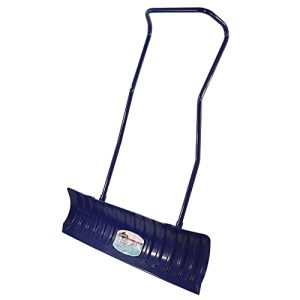
At 36 inches wide, the Yukon is the broadest pusher in this guide, and it is built for exactly one job: moving thin layers of light snow off large surfaces as fast as possible. Its shallow polyethylene blade lets snow slide up and over rather than piling into a wall in front of you, and the ergonomic steel handle keeps your body in a natural pushing position. Assembly uses a tool-free knock-down system, so it comes apart for storage. This is the pusher for long, straight driveways and open areas where every extra inch of width saves a pass.
Specs
- Blade: 36-inch polyethylene blade, shallow design so snow slides easily
- Handle: ergonomic steel handle with a large grip for two hands
- Weight: 3.3 pounds
- Grip: ergonomic grip
- Assembly: tool-free knock-down system
Best for: Homeowners with long, wide driveways who get light snow and want the fewest passes possible.
Watch out for: The shallow blade struggles once snow gets deeper than about five inches, and wet, heavy snow spills over the top, so this is not the tool for deep storms.
The Snowplow The Original Snow Pusher 24 Inches

The Snowplow pairs a 24-inch virgin UHMW polyethylene blade with a reinforced metal handle and a patented TUFFBRACE connector, a combination aimed at people who push snow off more than one kind of surface. The blade is non-stick, so snow slides off instead of clumping, and it is gentle enough for wood and composite decks as well as concrete and pavers. Flip the blade over and the cutting angle separates packed snow and chips at ice. Assembly is a simple bolt-together job that takes a few minutes with standard wrenches.
Specs
- Blade: 24-inch virgin UHMW polyethylene blade, non-stick
- Handle: reinforced metal handle with patented TUFFBRACE connector
- Grip: ergonomic D-style grip
- Dimensions: 54 x 24 x 4 inches
- Weight: 4.54 pounds
- Hardware: stainless steel, rust-free
Best for: Homeowners who clear decks, steps, sidewalks, and driveways with one tool and want a blade that will not scratch wood.
Watch out for: At 24 inches it takes more passes than the 36-inch Yukon on a wide driveway, and the bolt-together assembly needs a wrench on first setup.
Snow Joe Edge SJEG24 2-In-1 24-Inch Poly Blade Snow Pusher and Ice Chopper

The SJEG24 is two tools in one body: a 24-inch poly pusher for fresh snow and a 5-inch steel ice chopper that slides out of the shovel base when you meet packed ice. The scoop measures 24 by 11 inches, the coated steel tube keeps the weight down, and the cushioned foam D-grip stays comfortable through gloves. An aluminum wear strip runs along the scoop edge to extend its life on concrete. For a driveway that gets light snow most days and an icy patch at the curb once in a while, this single tool covers both jobs without a second trip to the garage.
Specs
- Blade: 24-inch by 11-inch polypropylene cold-resistant scoop
- Ice chopper: 5-inch steel ice chopper, slides out of the shovel base
- Wear strip: aluminum wear strip
- Handle: coated steel tube with cushioned foam D-grip
- Dimensions: 55 x 24 x 5.9 inches
- Weight: 3.5 pounds
Best for: Driveways where light snow is the norm but a frozen strip along the street or walkway needs chopping after a thaw and refreeze.
Watch out for: The chopper head adds a step when switching modes, and the poly scoop is built for snow, not for prying up thick ice sheets.
Suncast 24″ Combo Snow Shovel Pusher

The Suncast combo is the most versatile shape here: a flat edge for pushing snow forward and a curved back that collects snow for lifting it out of the way. That dual shape suits smooth paved surfaces, and the listing notes it excels at clearing dry snow of three to four inches. The blade carries an angled rib pattern that helps resist snow sticking, the galvanized steel wear strip protects the edge during hard use, and the steel shaft has a rust-resistant powder-coated finish. The D-grip handle gives a steady ergonomic hold for steering the wide blade.
Specs
- Blade: 24-inch blade with flat pushing edge and curved collecting back
- Wear strip: galvanized steel wear strip
- Shaft: steel shaft with rust-resistant powder-coated finish
- Handle: D-grip handle
- Dimensions: 51.25 x 24 x 12 inches
- Weight: 5.1 pounds
Best for: Smooth paved driveways and sidewalks where you want one tool that both pushes light snow and scoops the piles at the edges.
Watch out for: At 5.1 pounds it is the heaviest pusher in this guide, and the combo shape works best on smooth pavement rather than gravel or uneven ground.
Which One Fits Your Situation
A long, straight driveway with light snow
Pick the Garant Yukon YPP36KU. Its 36-inch blade covers a standard driveway slab in far fewer passes than any 24-inch tool, and at 3.3 pounds it stays easy to steer even when you are clearing the full length. The shallow blade is exactly right for two to four inches of powder. Keep a narrower shovel handy for the deeper storms, because this blade spills snow over the top once the depth rises.
Decks, steps, and mixed surfaces
Pick The Snowplow Original 24 Inches. Its UHMW blade is non-abrasive and safe on wood, composite decking, pavers, and concrete, so one tool covers the deck, the steps, and the walk without swapping. The flip-over cutting edge also helps separate packed snow along the edges of the deck. The 24-inch width is a good middle ground for the tighter turns around steps and railings.
Light snow with icy patches at the curb
Pick the Snow Joe Edge SJEG24. The 24-inch poly pusher handles the fresh snow, and the built-in 5-inch steel ice chopper slides out for the frozen ridge where the plow pushed slush against the curb. Carrying one tool instead of two matters when you are already dressed for the cold. The aluminum wear strip keeps the scoop edge in shape through a season of concrete contact.
A paved driveway where snow needs lifting too
Pick the Suncast 24-inch Combo. Its curved back collects snow so you can lift and toss the piles at the driveway edges, while the flat edge pushes the main snowfall forward. The galvanized wear strip and powder-coated steel shaft stand up to daily use on pavement. Accept the extra weight in exchange for not needing a second scoop shovel for the finishing work.
Common Mistakes
- Buying the widest blade available when your storms are usually deep: a 36-inch blade spills snow over the top once the depth passes the scoop, and you end up clearing the same stretch twice.
- Using a pusher on gravel or uneven ground, where the blade edge catches, digs in, and throws stones.
- Skipping the wear strip check: a bare plastic edge wears down quickly on rough concrete and leaves the blade ragged by midwinter.
- Pushing snow into a corner with no exit plan, then having to lift the whole pile by hand because the pusher cannot throw it over a bank.
- Storing a poly blade leaning against a sunny window or heater, which can warp the edge and make the blade track crooked next season.
Frequently Asked Questions
How wide should a snow pusher be for fresh light snow?
For fresh light snow, a 24-inch blade is the safest all-round choice, and a 36-inch blade is better if your driveway is long and straight and your snow stays under about four inches deep. Wider blades cut the number of passes, but they also push a heavier wall of snow, so depth matters more than width once storms get bigger.
Can a snow pusher replace a scoop shovel?
A pusher can replace a scoop shovel for light snow on flat surfaces, because you roll the snow to the edge instead of lifting it. It cannot replace a scoop shovel when you need to lift snow over a bank, clear steps, or dig out a car. Most households do best with a wide pusher for the driveway and a smaller scoop shovel for the detail work.
Does blade material matter for light snow?
Yes, because the blade is what touches the ground on every pass. Polyethylene blades are light and slide well, and UHMW polyethylene sheds snow better and resists cold cracking. A metal wear strip along the edge protects the blade from concrete. For light snow the difference shows up in how easily snow releases from the blade and how long the edge lasts.
What makes a snow pusher hard to use on a driveway?
Three things make a pusher hard to use: a blade wider than the snow depth can handle, a handle that is too short and forces you to hunch, and a blade edge that catches on cracks or gravel. A pusher also struggles when snow has nowhere to go, so plan your pushing direction toward an open edge or lawn before you start.
FAQ
How wide should a snow pusher be for fresh light snow?
Can a snow pusher replace a scoop shovel?
Does blade material matter for light snow?
What makes a snow pusher hard to use on a driveway?
More from Amazon
Programs that pair well with the guide above. Offers and eligibility are set by Amazon and may change.
Free shipping on eligible items, Prime Video and more. Eligible new members can start with a free trial.
Start a Prime free trialAudiobooks and podcasts to listen to on the go. Eligible new members can start with a free trial.
Try Audible freeAd-free music streaming. Eligible new subscribers can start with a free trial.
Try Music Unlimited freeA free business account with business pricing and bulk-buying tools for work, shop or home office.
Create a business accountAs an Amazon Associate we earn from qualifying purchases.


Write Your Review
No reviews yet. Be the first to share your experience!