
Key takeaways
- The best figure skates for kids, from warm first skates to stiffer junior boots for lessons. Compare fit, support, blades and sizing before you buy.
Buying a first pair of figure skates for a child means balancing two things that pull in opposite directions. A boot that is too soft lets the ankle wobble and makes every glide feel unsteady. A boot that is too stiff hurts, rubs blisters, and makes a child dread putting skates on. Growing feet make it harder: a fixed-size skate fits for one season, while an adjustable skate lasts longer but never fits as well.
This guide is for parents of toddlers, families in learn-to-skate classes, and parents of a child who skates a few times each winter. The five skates below come from names and specs on Amazon listings, all kids or junior listings, not adult models in a small size. One honest note: most kids figure skates are adjustable or first-skate models, not performance boots. The most recommended kids boot, the Jackson Classic 200, shares its listing with adult sizes already covered in this site’s general figure-skates guide, so this guide picks five distinct kids listings.
Quick Picks
As an Amazon Associate we earn from qualifying purchases.
| Product | Best for | Key spec from title |
|---|---|---|
| Riedell Soar Junior | The warmest first skate for a cold rink | 3M Thinsulate insulation |
| Riedell Horizon Junior | A beginner who needs steady ankle hold | Spiral stainless steel blades |
| Jackson Ultima Softec Vista | A child who values comfort above all | Soft Softec boot |
| Jackson Ultima Softec Rave | A toddler taking first steps | Toddler size 8 |
| Riedell Sparkle Junior | A child who wants glitter and style | Glitter accents |
How to Choose
Fit Before Anything Else
Fit decides everything else, and skate sizing does not match shoe sizing. Measure your child’s foot on paper while wearing skating socks, then check the maker’s own size chart instead of guessing from age or shoe size. Jackson skates often run about half a size large, so a careful measurement matters more than the number on the box. Leave a thumb-width of room at the toe, but no more: a boot with empty space behind the heel lets the foot slide, causing blisters. If the heel lifts when your child bends their knees, the size is wrong. A skate that fits well feels snug around the ankle and heel, with toes able to wiggle but not swim.
Support Rating and Ankle Hold
Every maker rates boot stiffness on its own scale. Riedell rates support from 1 to 100, with light recreational boots in the 0 to 30 band and lesson-ready boots near 40. A child in weekly lessons needs more hold than a child who skates twice a winter, because jumps load the ankle hard. The Horizon Junior, rated at 20, suits a new skater, while the Topaz Junior, rated at 40, is the step up for a child beginning jumps — though no live Amazon offer could be pinned for it, so it is not one of the five below. A stiff boot is wrong for a toddler: a very young child cannot bend a rigid ankle.
Blade Type and Toe Pick
Blades are not all the same, and the differences matter. A spiral blade, like the one on the Riedell Horizon Junior, is a smooth recreational blade, which suits a child learning edges and stops. A stainless steel blade holds its edge longer between sharpenings than a plain carbon steel blade, which is why most skates below use stainless steel. The toe pick is the set of teeth at the front of the blade: a small beginner pick helps with turns and stops, while a large pick trips a child who has not learned to use it yet. Check if the blade arrives sharpened. Some makers ship blades unsharpened, so budget for a professional sharpening before the first skate.
Warmth, Closure, and Growing Room
A cold rink punishes a thin boot, and a child with cold feet quits early. Insulation like 3M Thinsulate and a foam-backed lining keep small feet warm through an hour-long session, while a plain vinyl boot with no lining feels cold within minutes. Closure matters just as much: hook-and-loop straps let a small child get skates on and off alone, while laces give a tighter, more adjustable fit for an older child. Adjustable skates stretch across several sizes with a push-button or lever system, which saves money across growth spurts, but the adjustment adds weight and the fit is never as precise as a fixed size. Choose adjustable for a fast-growing toddler and fixed-size for a child in regular lessons.
The 5 Best Options
Riedell Soar Junior
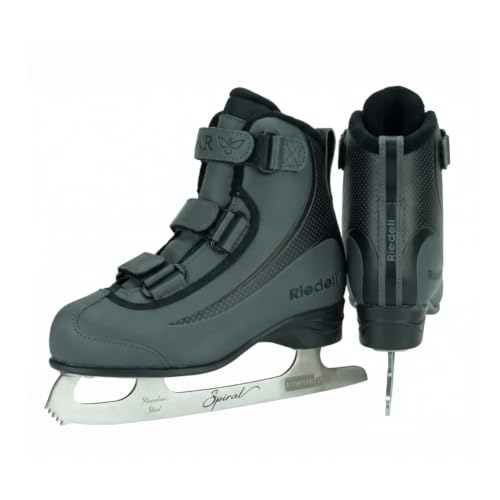
The Soar Junior is the warmest first skate in this guide, and warmth is what keeps a young child on the ice long enough to learn. Riedell built it as a sleek, insulated skate shoe with a foam-backed velvet lining and 3M Thinsulate insulation, so small feet stay warm through a full session. The smaller sizes close with hook-and-loop straps, which let a child get the skates on and off alone, while the larger sizes lace up for a tighter fit. It is a recreational skate, not a lesson boot, and that is exactly right for a child who is still learning to glide and stop.
Specs
- 3M Thinsulate insulation with a foam-backed velvet lining
- Stainless steel blades on PVC soles
- Hook-and-loop straps in smaller sizes, laces in larger sizes
- Support rating in the light 0 to 30 band
- Part number 513251010, sizes from 1 JR
Best for: A young child skating for fun on cold rinks who needs warmth and easy on-off.
Watch out for: This is a light recreational skate, so a child in weekly lessons who is beginning jumps will outgrow its support fast — confirm the junior size in the selector, since the adult Soar shares the same family name.
Riedell Horizon Junior

The Horizon Junior gives the steadiest ankle hold in this guide for a child who is new to skating but wants to keep improving. It carries a support rating of 20, with a modern ergonomic toe fit and a plush rolled collar that holds the ankle without pinching. The spiral stainless steel blade glides smoothly and forgives wobbly edges while a beginner learns stops and turns. A waterproof synthetic upper keeps slush out of the boot, and the skate comes in white and black. It is a genuine junior listing, sized from 1 JR, for the child who skates regularly but is not yet jumping.
Specs
- Support rating of 20 on Riedell’s scale
- Spiral stainless steel blades on PVC soles
- Modern ergonomic toe fit with a plush rolled collar
- Waterproof synthetic upper in white and black
- Sizes from 1 JR, first available March 10, 2023
Best for: A beginner in regular skating sessions who needs steady ankle hold and a forgiving blade.
Watch out for: Confirm the listing says Junior and shows junior sizes, since the adult Horizon listing is a different ASIN already used in an earlier guide.
Jackson Ultima Softec Vista

The Softec Vista is the comfort pick, built for the child who cares more about how skates feel than how fast they go. Jackson’s Softec program is built for comfort, warmth, and durability, with a soft nylon boot needing almost no break-in. That matters for a child who quit because stiff boots hurt: the Vista feels good from the first session, with a Nylex lining and memory foam ankle padding cushioning the foot. Coaches place the Vista at the very beginning level: first lessons, balance, gliding, stops, and basic edges. It will not carry a child into jumps, but it will carry a hesitant child through the first season.
Specs
- Softec series boot, model ST3201, for girls
- Soft nylon upper with a Nylex lining
- Memory foam ankle padding with a flex notch and rolled collar
- Stainless steel recreational blade, factory sharpened
- Youth 1 size shown on the listing
Best for: A hesitant child who needs a comfortable first skate with almost no break-in.
Watch out for: The listing is sold by a third-party seller under the SKATE GURU name, so confirm a live offer and the exact size before ordering — and note this is a beginning-level skate, not a boot for jumps.
Jackson Ultima Softec Rave

The Softec Rave is the toddler pick, because almost nothing else fits a two- or three-year-old properly. Jackson built it as a soft-boot figure skate in toddler sizes, with a black and purple color scheme young kids love and a factory-sharpened recreational blade ready to glide. The soft boot with its external skeletal structure gives a small child ankle support without a rigid shell that would stop a toddler bending their knees. At toddler size 8, it is one of the smallest real figure skates sold on Amazon, and the right choice for a very young child’s first time on the ice.
Specs
- Softec series boot, model RV2001, for girls
- Soft boot with an external skeletal structure
- Recreational blade, factory sharpened
- Black with purple, toddler size 8 shown on the listing
- Part number 061178268852
Best for: A toddler taking first steps on the ice who needs the smallest real figure skate available.
Watch out for: A toddler outgrows this skate in a single season, so buy the size that fits now rather than sizing up for growth — and check the blade guard situation, since tiny blades dull fast when walked on bare floors.
Riedell Sparkle Junior

The Sparkle Junior is the style pick, and style matters more than adults admit: a child who loves how their skates look asks to skate again. Riedell built the Sparkle 22 as a recreational skate with glitter accents on a supportive upper, so it looks right to a seven-year-old while still holding the ankle properly. The stainless steel blades and PVC soles match the rest of the Riedell junior line, and the skate comes in ice blue. It is a recreational skate with light support, for a child skating for fun and basic lessons rather than working on jumps.
Specs
- Glitter accents on a supportive upper
- Stainless steel blades on PVC soles
- Ice blue color, sizes from 1 JR
- Support rating in the light 0 to 30 band
- Part number 523351010
Best for: A child who wants glitter and style and skates for fun or in beginner lessons.
Watch out for: The glitter finish shows scuffs easily, and this is a light recreational skate — a child beginning jumps needs a stiffer boot, so do not buy it as a lesson boot for an advancing skater.
Which One Fits Your Situation
A Toddler Taking First Steps on the Ice
Pick the Jackson Ultima Softec Rave, the only skate here in true toddler sizes. Its soft boot lets a very young child bend their knees without fighting a rigid shell. The factory-sharpened blade is ready to glide, and the black and purple colors appeal to small kids. Buy the size that fits now, since a toddler outgrows skates in one season, and add blade guards from day one so the tiny blades survive the walk to the ice.
A Child in Weekly Learn-to-Skate Classes
Pick the Riedell Horizon Junior. Its support rating of 20 and ergonomic toe fit hold the ankle steady through repeated lessons, while the spiral blade forgives wobbly edges while learning stops and turns. The waterproof upper handles slushy rink conditions, and the plush collar keeps the boot comfortable through long sessions. If your child begins working on single jumps, plan the next step up: the stiffer Riedell Topaz Junior, rated at 40, is the natural upgrade.
A Child Who Skates a Few Times Each Winter
Pick the Riedell Soar Junior. Warmth matters most for an occasional skater, and the Thinsulate insulation and foam-backed velvet lining keep small feet warm in a public session. Hook-and-loop straps in smaller sizes let a child get the skates on alone, which matters when the family is rushing to the rink. It is a recreational skate, so do not expect it to carry a child into lessons, but for a few outings each winter it is the most comfortable choice.
A Child Who Wants Comfort and Style
Pick the Softec Vista for comfort, or the Sparkle Junior for style. The Vista’s soft boot with memory foam padding needs no break-in, which suits a child who disliked stiff boots. The Sparkle Junior adds glitter accents to a supportive recreational skate, so a child gets the look they want without giving up ankle hold. Either way, measure the foot first: both makers size differently from street shoes, and a wrong size ruins even the most comfortable skate.
Common Mistakes
- Buying the adult model in a small size instead of a kids or junior listing — adult boots are stiffer, heavier, and shaped for adult feet.
- Skipping the professional sharpening — several makers ship blades unsharpened, and dull blades make a child slip and lose confidence.
- Buying two sizes up for growth — a boot with empty space behind the heel causes blisters and wobbly ankles.
- Choosing an adjustable skate for a child in serious lessons — the adjustment adds weight and never fits as precisely as a fixed size.
- Walking on bare floors without blade guards — a few steps across concrete dulls a new blade and shortens its life.
Frequently Asked Questions
What size figure skates should I buy for my child?
Measure your child’s foot on paper in skating socks and check the maker’s size chart. Skate sizing does not match shoe sizing: Jackson often runs about half a size large, while others run small, so guessing from shoe size usually fails. Leave a thumb-width at the toe for growth, but no more. If the heel lifts when your child bends their knees, exchange the size before the first lesson.
Do kids need their blades sharpened before the first skate?
Often yes. Some makers ship blades unsharpened, and a dull blade makes a child slip, which kills confidence fast. Budget for a professional sharpening before the first session, and ask whether the blade is a beginner or competition blade, since the hollow grind differs. After that, sharpen every 20 to 30 hours on the ice. Always use blade guards when walking off the ice.
Are adjustable figure skates good for lessons?
Adjustable skates suit a fast-growing casual skater, but they are a compromise for lessons. The push-button or lever system adds weight, and the fit is never as precise as a fixed-size boot, which matters for learning edges and turns. For a child in weekly lessons, a fixed-size skate like the Horizon Junior holds the ankle better. Save adjustable skates for toddlers and occasional skaters, where growth matters more than precision.
When should a child move to a stiffer figure skate?
Move up when the boot folds at the ankle in jumps, or when the coach says so. A child beginning single jumps needs a boot near Riedell’s 40 rating, such as the Topaz Junior, while a child learning glides and stops is fine in a light boot. Do not rush it: a boot too stiff for a child’s weight and skill hurts and slows progress more than a soft boot.
FAQ
What size figure skates should I buy for my child?
Do kids need their blades sharpened before the first skate?
Are adjustable figure skates good for lessons?
When should a child move to a stiffer figure skate?
More from Amazon
Programs that pair well with the guide above. Offers and eligibility are set by Amazon and may change.
Free shipping on eligible items, Prime Video and more. Eligible new members can start with a free trial.
Start a Prime free trialAudiobooks and podcasts to listen to on the go. Eligible new members can start with a free trial.
Try Audible freeAd-free music streaming. Eligible new subscribers can start with a free trial.
Try Music Unlimited freeA free business account with business pricing and bulk-buying tools for work, shop or home office.
Create a business accountAs an Amazon Associate we earn from qualifying purchases.
Write Your Review
No reviews yet. Be the first to share your experience!