
Key takeaways
- Five winter-ready camping lanterns compared: rechargeable, battery, and candle light, with cold-weather runtimes and what to check before you buy.
Winter camping changes what a lantern has to do. Nights run long, temperatures fall below freezing, and a dead battery at midnight is more than an annoyance when the tent is buried in snow. The choice is not only about brightness: it is about which power source still works when it is cold, how long the light lasts on a low setting, and whether the lantern hangs, stands, or tips over in a snowdrift.
This guide is for winter tent campers who need reliable light for cooking and reading after dark, for group basecamp leaders lighting a shared table, and for anyone building a cold-weather emergency kit. The five lanterns below were chosen from names and specs on Amazon listings: a dual-power rechargeable, a hand-crank hub, two long-running battery models, and one candle lantern for nights when batteries are not the answer.
Quick Picks
As an Amazon Associate we earn from qualifying purchases.
| Product | Best for | Key spec from title |
|---|---|---|
| Black Diamond Apollo Lantern | Multi-day winter trips with no outlet | 250 lumens, rechargeable plus AA backup |
| Goal Zero Lighthouse 250 Lantern | Charging a phone while lighting camp | 250 lumens, USB, solar, and hand crank |
| Streamlight Siege 540 Lantern | Lighting a large tent in deep cold | 540 lumens, 3 D batteries |
| UST 30-Day Duro Lantern | A lantern that runs for weeks on one set of batteries | 700 lumens, up to 30 days on low |
| UCO Original Candle Lantern | Silent light with no batteries at all | Candle-powered, 9 hours per candle |
How to Choose
Cold-Weather Power Comes First
Cold is the first filter for a winter lantern, because batteries lose capacity as the temperature falls. Lithium AA cells keep working far below freezing, while standard alkaline cells fade fast and can leak when they warm up again. A built-in rechargeable pack is convenient near a vehicle or power bank, but it is useless once it is flat and there is no outlet for days. The safest winter setup pairs a rechargeable lantern with a battery backup, or carries a second power source entirely. Before any trip, check the lantern’s battery type and carry spares in an inside pocket, where body heat keeps them ready.
Lumens Against Runtime
A lantern that blasts 500 lumens looks impressive for ten minutes and then eats its batteries before midnight. Winter nights are long, so runtime on a low or medium setting matters more than the headline number. A 150 to 250 lumen lantern on a dim setting lights a tent well enough to cook, read, and sort gear, and it can run for several nights. Look for a lantern with a smooth dimmer rather than only two or three fixed levels, so you can drop the output to a soft glow once the cooking is done. Compare the low-setting runtime in the listing, not the maximum.
Weight, Size, and How It Hangs
A lantern that only stands on a table is less useful in a tent, where the best light hangs from the ceiling loop and spreads evenly. Folding legs, a top hook, and a hanging loop each change where the light lands. Weight matters more in winter, when every pack already carries extra insulation, fuel, and food: a lantern under half a pound suits a backpacking tent, while a heavier D-battery model belongs in a sled or a car-camping box. Collapsible models pack flat, which helps when the tent, sleeping bag, and stove already fill the bag.
Weather Protection and Flame Rules
Rain, wet snow, and condensation are part of winter camping, so check the water rating before you buy. An IPX4 rating shrugs off splashes and falling snow, while an IPX7 rating means the lantern survives a dunk in a meltwater puddle and some models even float. A candle lantern is a different class entirely: it gives warm, silent light with no batteries, but it is an open flame, so it must never burn unattended inside a tent or near sleeping bags and fabric walls. Keep any flame clear of the tent ceiling, and carry spare candles in a sealed bag.
The 5 Best Options
Black Diamond Apollo Lantern

The Apollo is the most flexible lantern here for a winter trip that mixes cold nights with days near a vehicle. Its rechargeable pack handles the first nights, and three AA cells take over when the pack is flat, which is exactly the backup a multi-day trip needs. The folding legs stand it on a snow-covered table, the hook hangs it from a tent loop, and the dimmer drops the output low enough for reading without waking the whole tent.
Specs
- 250 lumens maximum output, dimmable
- Rechargeable 2,600 mAh battery, plus 3 AA batteries as backup
- 24 hours on high, 150 hours on low (Black Diamond’s own figures)
- IPX4 splash rating
- About 7 oz without batteries installed
- Folding legs and hang hook, frosted globe
Best for: Winter campers who want rechargeable convenience with a battery backup for long trips.
Watch out for: The AA backup cells are not included, so buy them separately, and pack lithium AAs rather than alkaline ones for sub-freezing nights.
Goal Zero Lighthouse 250 Lantern

The Lighthouse 250 is the lantern to pack when the phone also needs power. Its hand crank is the feature that matters most in winter: one minute of cranking gives about ten minutes of light, so a dead battery never means a dark tent. It recharges from USB or a solar panel as well, and its USB output tops up a phone or headlamp. The two-sided light can shine from one side only, which stretches the runtime when only a small pool of light is needed.
Specs
- 250 lumens maximum output
- Recharge by USB, solar panel, or built-in hand crank
- USB output to charge small devices
- Run time 2.5 to 28 hours (Amazon listing)
- Dimmable DuaLite directional lighting, one or both sides
- Model 32001
Best for: Campers who want a lantern that also charges a phone and never depends on a single power source.
Watch out for: The listing prints two different runtime figures, a 2.5 to 28 hour range and a 48 hour battery-life field, so treat the low end as the honest number and confirm the exact listing before ordering.
Streamlight Siege 540 Lantern
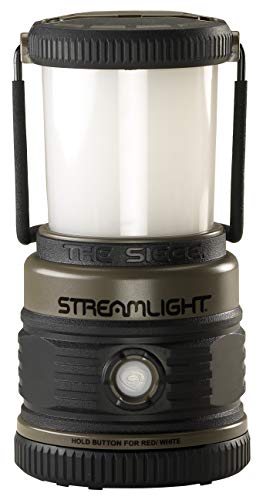
The Siege 540 is the workhorse for a big tent or a group site in deep cold. Three D batteries give it a long, steady run, and 540 lumens spreads a soft, even glow across a whole table instead of a single bright spot. Its removable glare cover softens the light for reading, and the lantern is built to survive a drop in the snow and a dunk in meltwater. D batteries are heavy, so this is a sled or car-camping lantern rather than a backpacking one.
Specs
- 540 lumens maximum output
- 3 D batteries
- 360-degree soft, even light
- Removable glare-reducing cover
- IPX7 waterproof to 1 m, floats
- Up to 295 hours on the lowest setting (roundup figure)
Best for: Lighting a large tent or group campsite through a long, cold night.
Watch out for: Confirm the listing is the 540-lumen D-battery Siege, model 44931, since Streamlight sells smaller AA versions under the same Siege name.
UST 30-Day Duro Lantern

The Duro is the lantern for trips where recharging is simply not an option. Its headline feature is endurance: on the lowest setting it runs for up to 30 days on one set of three D batteries, which covers a whole expedition and a long emergency kit stay. It still puts out a strong beam on high for finding gear outside the tent, and its built-in hook hangs it from a branch or a tent loop. The trade is weight, at nearly two pounds loaded, so it travels in a sled or a vehicle, not a pack.
Specs
- 700 lumens (Amazon listing title)
- 3 D batteries
- Up to 30 days on low, 30 hours on medium, 12 hours on high (roundup figures)
- IPX4 water resistant
- Limited lifetime warranty
- 1.9 lbs loaded with batteries, built-in hook
Best for: Extended off-grid trips and emergency kits where runtime matters more than weight.
Watch out for: Roundups print 1,000 lumens for this lantern while the Amazon listing title prints 700, so trust the listing figure and buy for the runtime, not the headline brightness.
UCO Original Candle Lantern

The UCO is the only lantern here with no battery at all, and that is its whole point. A candle burns for hours in any temperature, needs no charging, and gives a warm, silent light that suits a quiet night in a small tent. The spring-loaded tube keeps the candle at a constant height as it burns, the glass chimney shields the flame from wind, and the whole lantern collapses to just over four inches for packing. It is dim beside the LED models, so treat it as a companion light, not the only light.
Specs
- Candle-powered, no batteries required
- Collapses to 4.25 in, opens to 6.5 in; 2 in diameter
- About 6.4 oz with candle (aluminum)
- Spring-loaded candle tube and glass chimney
- 9-hour candle per the listing; newer value-pack listings print 15-hour candles
- 39 lumens printed on the value-pack listing for the same lantern
Best for: Quiet nights in a small tent and as a battery-free backup when every cell is flat.
Watch out for: UCO sells several near-identical Original listings with different candle packs, so confirm the exact listing and candle count before ordering, and never leave the flame burning unattended in a tent.
Which One Fits Your Situation
Multi-Day Winter Trip With No Outlet
Take the Black Diamond Apollo. Its rechargeable pack covers the first nights, and the AA backup takes over when the pack is flat, which is the exact failure that ends most winter trips in the dark. Pack lithium AAs in an inside pocket so they stay warm, and run the lantern on a low dimmer setting once the cooking is done to stretch the pack across several nights.
Lighting a Big Tent or Group Site
Take the Streamlight Siege 540. Its 540 lumens and 360-degree glow cover a whole table, and three D batteries keep it running through a long night without a recharge. The removable glare cover softens the light for reading and cards, and the IPX7 body survives snow, slush, and a dunk in meltwater without complaint.
A Quiet Night Inside a Small Tent
Take the UCO Original Candle Lantern, paired with a small LED for tasks. The candle gives a warm, silent glow that suits reading and winding down, and it works in any temperature with no battery to nurse. Keep it clear of fabric, never leave it burning while you sleep, and carry spare UCO candles in a sealed bag.
A Lantern for the Emergency Kit
Take the UST 30-Day Duro. Its month-long low-setting runtime means it still works after sitting in a kit box for a season, and three D batteries are easy to store and replace. Add the Goal Zero Lighthouse 250 as a second light if the kit also needs a phone charger and a hand crank for nights when the batteries are gone.
Common Mistakes
- Running the lantern on full brightness all evening, then having no light left for the midnight trip outside the tent.
- Packing standard alkaline batteries for a sub-freezing trip, where they fade fast and can leak as they warm up.
- Treating a candle lantern like an LED and leaving the flame burning unattended inside a tent or near fabric.
- Buying a lantern that only stands on a table, then finding no way to hang it from the tent ceiling loop.
- Forgetting spare candles or spare batteries, so a single dead power source ends the light for the whole trip.
Frequently Asked Questions
Do rechargeable lanterns work in freezing weather?
Rechargeable lithium packs work in the cold, but they lose capacity as the temperature falls, so a lantern that runs for hours at home may run for much less time at minus ten degrees. Keep the lantern inside your sleeping bag or jacket when it is not in use, and carry a battery-powered backup so a flat pack never leaves you in the dark.
How many lumens do I need for winter camping?
A 150 to 250 lumen lantern on a dim setting lights a tent well enough to cook, read, and sort gear, while 400 to 540 lumens suits a large tent or a group table. More important than the maximum is the low-setting runtime, since winter nights are long and a bright lantern that dies by midnight is worse than a dim one that lasts until dawn.
Can I use a candle lantern inside a tent?
A candle lantern can light a tent, but it is an open flame, so never leave it burning while you sleep and keep it well clear of the ceiling, walls, and sleeping bags. Use it for reading and winding down, keep a small LED handy for moving around, and let the candle burn out or blow it out before you settle in for the night.
Are lithium AA batteries worth it for winter camping?
Yes, lithium AA cells are worth the extra cost in winter because they keep their voltage far below freezing, weigh less than alkaline cells, and do not leak as they warm up. Use them in any AA-powered lantern and in headlamps too, and keep spares in an inside pocket where body heat keeps them ready to use.
FAQ
Do rechargeable lanterns work in freezing weather?
How many lumens do I need for winter camping?
Can I use a candle lantern inside a tent?
Are lithium AA batteries worth it for winter camping?
More from Amazon
Programs that pair well with the guide above. Offers and eligibility are set by Amazon and may change.
Free shipping on eligible items, Prime Video and more. Eligible new members can start with a free trial.
Start a Prime free trialAudiobooks and podcasts to listen to on the go. Eligible new members can start with a free trial.
Try Audible freeAd-free music streaming. Eligible new subscribers can start with a free trial.
Try Music Unlimited freeA free business account with business pricing and bulk-buying tools for work, shop or home office.
Create a business accountAs an Amazon Associate we earn from qualifying purchases.
Write Your Review
No reviews yet. Be the first to share your experience!