
Key takeaways
- Compare the best winter gloves for men for shoveling, commuting, and cold days — waterproof, insulated, and leather options matched to real winter jobs.
A winter glove has to do three jobs at once: keep heat in, keep water out, and still let you grip a shovel handle, a steering wheel, or a ski pole. Most gloves only manage two of the three, and the one they drop is usually the one you notice first on a cold morning. The choice is not really about finding the warmest glove on a shelf. It is about matching the glove to the job your hands actually do, because a heavy ski gauntlet is the wrong tool for driving, and a thin fleece glove is the wrong tool for clearing a driveway in wet snow.
This guide is the men’s guide to winter gloves, split from the general winter-gloves post on this site, which compares gloves by price tier rather than by who wears them. The five gloves below come from names and specs printed on their Amazon listings, and they cover different winter jobs: shoveling, commuting, and cold days on the mountain.
Quick Picks
As an Amazon Associate we earn from qualifying purchases.
| Product | Best for | Key spec from title |
|---|---|---|
| Carhartt Men’s Waterproof Insulated Knit Cuff Glove | Shoveling and outdoor work in wet snow | Waterproof insert with knit cuff |
| MCTi Waterproof Insulated Men’s Winter Gloves | Cold, wet days with a sealed cuff | 3M Thinsulate C40 with zipper pocket |
| Kinco 1927KW Lined Premium Pigskin Glove | Heavy outdoor work in dry cold | Premium grain pigskin palm |
| Under Armour Men’s Storm Fleece Gloves | Commuting and driving on cold days | UA Storm water repellent fleece |
| Columbia Men’s Whirlibird Glove | Ski days and wet snow | Omni-Tech waterproof breathable shell |
How to Choose
Warmth and Insulation
Insulation is measured in grams on some listings and not mentioned at all on others, so the first job is to read what the listing actually prints. A glove that names its insulation, such as 3M Thinsulate or a gram figure, gives you something to compare. A glove that only says “insulated” asks you to trust the brand name instead of a number. Thickness is not the same as warmth either. A bulky glove can still let cold air in at the wrist, while a closer glove with a good cuff can hold heat longer. Think about how long your hands stay out. A ten-minute walk to the car needs far less insulation than an hour of shoveling.
Waterproofing and Wind
Waterproof is a word that means different things on different listings, and the difference matters on a wet day. A glove with a named membrane or a waterproof insert has a layer built to block liquid water, while a glove that only says water resistant or water repellent has a surface treatment that sheds light snow and then gives up. Wind matters just as much, because a cold wind pulls heat straight through a loose weave even when no snow is falling. Look for a windproof layer or a tightly woven shell if your winter means open chairlifts or long walks in a crosswind. A glove that prints no millimetre figure for water resistance is a flag, not a promise.
Fit, Cuff, and Sizing
A glove that fits badly is cold no matter how much insulation it carries, because loose fingers leave air gaps and tight fingers cut off circulation. Measure your hand around the knuckles and compare that number to the maker’s size chart, rather than guessing from your usual clothing size. The cuff is the second half of the fit. A gauntlet cuff pulls over a jacket sleeve and seals out snow on a fall, while a knit cuff sits under the sleeve and keeps debris out but lets snow in if you plunge a hand into a drift. A drawstring, a wrist strap, or a zipper closure all do the same job in different ways.
Grip, Touchscreen, and Dexterity
Warmth is useless if you cannot hold anything, so check the palm before you check the insulation. A leather palm grips a shovel handle and a ski pole better than smooth nylon, and a rubber or silicone print adds grip on a steering wheel or a phone. Touchscreen fingertips matter more than most buyers expect, because taking a glove off to answer a call exposes a bare hand to the coldest air of the day. Some gloves put conductive material on the thumb and index finger only, while others cover the whole palm, so confirm which fingertips work before you buy. Finally, remember that a mitten keeps fingers warmer than any glove by letting them share heat.
The 5 Best Options
Carhartt Men’s Waterproof Insulated Knit Cuff Glove

This is the work glove of the guide, built for a driveway, a job site, or a frozen tailgate rather than for a chairlift. The shell is 100% polyester with a 100% polyurethane palm, and a waterproof insert sits behind that shell so slush on a shovel handle does not soak through to your fingers. Ultrasoft synthetic insulation warms the hand from the moment you pull the glove on, and a FastDry lining moves sweat away from the skin. A soft fleece knit cuff with an adjustable wrist strap seals the wrist, which is the detail that keeps snow and slush out when you are working low to the ground.
Specs
- Shell: 100% polyester; palm: 100% polyurethane; lining: 100% polyester
- Waterproof insert with ultrasoft synthetic insulation
- FastDry sweat-wicking lining
- Soft fleece knit cuff with adjustable wrist strap
- Reinforced shell with grippy palm
- Model A511
Best for: Shoveling, scraping a windshield, and outdoor work in wet snow.
Watch out for: Carhartt does not state touchscreen fingertips on this listing, so the phone stays in the pocket. The insulation weight is not printed either, so warmth is judged by the insert and the lining rather than by a gram figure. Carhartt sells several insulated gloves under similar names, so confirm the A511 knit-cuff listing before ordering.
MCTi Waterproof Insulated Men’s Winter Gloves with Zipper
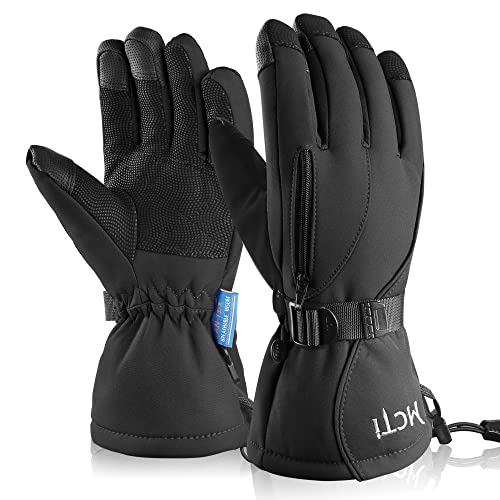
This is the budget cold-weather glove of the guide, and its selling point is a sealed cuff at a modest build. The three-layer softshell blocks wind and snow, and a waterproof TPU membrane insert sits inside that shell with a listed water pressure resistance of 10,000 mmH2O. Insulation is 3M Thinsulate C40, which keeps warmth without the bulk of a heavy down fill, and the listing pairs it with a soft polyester lining. A zipper pocket on the back of the hand holds a key, an ID card, or a small hand warmer, and an adjustable buckle wrist strap plus a drawstring closure seal the cuff against cold air.
Specs
- 3M Thinsulate C40 insulation
- Three-layer softshell with waterproof TPU membrane insert
- Water pressure resistance: 10,000 mmH2O
- Zipper pocket on the back of the hand
- Adjustable buckle wrist strap and drawstring closure
- Nuback palm with reinforced rubber fingers
- Nose wipe fabric on the thumb
- Touchscreen-compatible fingers
Best for: Skiing, snowmobiling, and long cold days in wet snow.
Watch out for: This glove is bulkier than a slim everyday glove, so fine work such as adjusting bindings or handling small buckles takes more effort. The zipper pocket is small and fits a key or a card, not a phone. Confirm the exact zipper-model listing, because MCTi sells several gloves under near-identical names with different insulation.
Kinco 1927KW Lined Premium Grain Pigskin Glove

This is the leather work glove of the guide, and it earns its place on the palm rather than on a membrane. The palm is premium golden grain pigskin, which stays soft and grippy when damp, while the back is a striped cotton-blend canvas that breathes instead of trapping sweat. Heatkeep thermal insulation lines the inside, with a TR2 inner lining that wicks moisture away from the hand. A polyester and elastic knit wrist with a leather pull-tab keeps debris out and makes the glove easy to pull on with cold fingers, and the wing thumb and gunn cut pattern shape the glove around a tool handle.
Specs
- Premium golden grain pigskin palm
- Striped cotton-blend canvas fabric back
- Heatkeep thermal insulation with TR2 inner lining
- Polyester and elastic knit wrist with leather pull-tab
- Wing thumb design with gunn cut pattern
- Style number 1927KW
Best for: Heavy outdoor work in dry cold, from firewood to fence repairs.
Watch out for: This glove is not waterproof. The canvas back and knit wrist breathe well, but they will soak through in wet snow, so it belongs on dry cold days rather than on slushy ones. The listing says do not wash the glove, and leather needs care to stay supple after wet-dry cycles. Confirm the 1927KW knit-wrist listing, because Kinco sells the same palm with a safety cuff under a different style number.
Under Armour Men’s Storm Fleece Gloves

This is the light-duty glove of the guide, made for commuting, driving, and walking the dog rather than for deep snow. The outside is a smooth sweater-fleece fabric with a heathered look, and a brushed Armour Fleece interior lining traps heat without adding bulk. UA Storm technology gives the fleece a water-repellent finish, so light snow beads and rolls off instead of soaking straight in, while the fabric stays breathable enough for a brisk walk. Conductive suede tips on the thumb and index finger let you use a phone without taking the glove off, and a microfiber palm pad adds grip and durability where the hand meets the wheel.
Specs
- Fabric: 100% polyester
- UA Storm water-repellent finish
- Brushed Armour Fleece interior lining
- Conductive suede touchscreen tips on thumb and index finger
- Microfiber palm pad for grip and durability
- Extra soft Speedwipe fleece on the back of the thumb
- Extended wrist cuff for added coverage
- Style number 1365958
Best for: Commuting, driving, and everyday cold days with light snow.
Watch out for: Water repellent is not waterproof, so this glove will wet through in heavy snow or a long shoveling session. The touchscreen coverage differs across retailer listings, with one listing describing Tech Touch on the entire palm and the maker’s own page naming only the thumb and index finger, so confirm the exact listing. It is the lightest glove here, and it is not the pick for the coldest mornings.
Columbia Men’s Whirlibird Glove

This is the mountain glove of the guide, and it brings a named waterproof shell to wet snow days. The shell uses Omni-Tech waterproof breathable fabric, and an Omni-Heat thermal reflective lining bounces body heat back toward the hand. Insulation is Microtemp XF II, made from 85% recycled polyester, which holds warmth without the weight of a heavy fill. A durable PU palm gives grip on poles and rails, and the glove adds a touchscreen-compatible fingertip, a nose wipe on the thumb, an elastic wrist, and an adjustable strap to seal out cold air. A three-point precurve cut shapes the glove to a natural hand position.
Specs
- Omni-Tech waterproof breathable shell
- Omni-Heat thermal reflective lining
- Microtemp XF II insulation, 85% recycled polyester
- Touchscreen-compatible fingertip
- Durable PU palm fabric
- Nose wipe on the thumb
- Elastic wrist with adjustable strap
- Three-point precurve fit
- Model 1827671
Best for: Ski days, resort laps, and wet snow when a named membrane matters.
Watch out for: No insulation gram figure is printed on the listing, so warmth is judged by the lining and the insulation name rather than by a number. Columbia also sells the Whirlibird III under a similar name, so confirm the exact 1827671 listing before ordering. One roundup notes limited size availability on this listing, so check your size is in stock rather than assuming it.
Which One Fits Your Situation
For Shoveling and Outdoor Work
Pick the Carhartt knit-cuff glove for a driveway, a yard, or a job site in wet snow. The waterproof insert and the fleece knit cuff with an adjustable strap keep slush out of the wrist while the reinforced palm grips a shovel handle. The Kinco pigskin glove is the second choice here, but only on dry cold days, since its canvas back is not waterproof. Skip the fleece glove for shoveling: a water-repellent finish wets through fast.
For Commuting and Driving
Pick the Under Armour Storm Fleece glove for a walk to the car, a train platform, or a drive across town. It is the lightest glove here, it fits under a coat cuff without bunching, and the touchscreen tips mean the phone stays in use without a bare hand in the cold. The extended wrist cuff adds coverage where a jacket sleeve ends. On a morning with heavy snow rather than light flurries, switch to the Columbia Whirlibird.
For Ski Days and Wet Snow
Pick the Columbia Whirlibird when the forecast is wet, heavy snow and the day is spent on lifts. The Omni-Tech shell and the Omni-Heat lining keep hands dry from the outside while reflecting heat back on the inside, and the adjustable strap seals the cuff against snow on a fall. The MCTi glove is the budget alternative for the same job, with a thicker feel and a zipper pocket for a key or a hand warmer.
For the Coldest Mornings
Pick the MCTi glove when the temperature drops hardest and the day will be long. The 3M Thinsulate C40 insulation and the sealed cuff with a buckle strap and a drawstring are built for sustained cold, and the waterproof membrane keeps wet snow from reaching the lining. If your hands still run cold, a mitten is the honest upgrade for the coldest days, since shared fingers stay warmer than separated ones. Add a thin liner for extra warmth.
Common Mistakes
- Buying a water-repellent glove for wet snow work: a surface treatment sheds light flurries, but only a named membrane or a waterproof insert holds up to slush and wet snow.
- Ignoring the cuff: a glove with a loose wrist lets snow and cold air in no matter how much insulation the listing claims, so close the strap, the drawstring, or the zipper every time.
- Choosing by insulation weight alone: a gram figure says nothing about the cuff seal, the windproofing, or the fit, and a bulky glove with a bad cuff can feel colder than a closer glove with less fill.
- Assuming every glove works with a phone: some gloves put conductive material on two fingertips only, some cover the whole palm, and some have none at all, so confirm which fingertips work before you buy.
- Treating a leather work glove as waterproof: pigskin and cowhide grip well and stay soft when damp, but a leather palm with a canvas back will soak through in wet snow, so save it for dry cold days.
Frequently Asked Questions
Are men’s winter gloves different from unisex gloves?
Men’s gloves are sized from a men’s hand chart, with wider palms and longer fingers at the same letter size, while unisex gloves split the difference and fit neither hand as well. The difference shows up most in the fingers, where a glove that is too long bunches at the tips and loses grip. Measure around the knuckles and compare that number to the maker’s chart.
Should I choose gloves or mittens for winter?
Gloves win when you need your fingers apart, for buckles, zippers, poles, and tools, while mittens win when warmth is the only thing that matters. A mitten lets your fingers share heat, so it stays warmer than any glove of the same thickness on the coldest days. Many skiers keep both: gloves for everyday laps and mittens for the coldest mornings or for long lift rides in wind.
How do I keep winter gloves waterproof longer?
Wash them only as the care label allows, with a gentle detergent and no fabric softener, which can coat a membrane and cut its breathability. Let them air dry away from direct heat, and reapply a durable water repellent spray when water stops beading on the shell. Leather gloves need a different routine: keep them clean and dry, and treat the leather as the maker directs so it stays supple.
Do I need insulation for mild winter days?
A lighter glove suits mild days, because a heavy insulated glove makes hands sweat, and damp hands chill fast once you stop moving. A fleece glove with a water-repellent finish is enough for commuting and errands in light snow, while an insulated glove with a waterproof insert earns its place on shoveling days and long cold outings. Match the insulation to the longest stretch your hands will spend outside.
FAQ
Are men’s winter gloves different from unisex gloves?
Should I choose gloves or mittens for winter?
How do I keep winter gloves waterproof longer?
Do I need insulation for mild winter days?
More from Amazon
Programs that pair well with the guide above. Offers and eligibility are set by Amazon and may change.
Free shipping on eligible items, Prime Video and more. Eligible new members can start with a free trial.
Start a Prime free trialAudiobooks and podcasts to listen to on the go. Eligible new members can start with a free trial.
Try Audible freeAd-free music streaming. Eligible new subscribers can start with a free trial.
Try Music Unlimited freeA free business account with business pricing and bulk-buying tools for work, shop or home office.
Create a business accountAs an Amazon Associate we earn from qualifying purchases.
Write Your Review
No reviews yet. Be the first to share your experience!