
Key takeaways
- Compare the best ski boots for men, from a soft-flex Nordica Cruise to a stiff Tecnica Mach1 MV 120, with flex, last width and fit explained.
Buying ski boots online feels like a gamble because the two numbers that matter most — flex and last width — are easy to misread. A boot that is too stiff fights you all day, a last that is too narrow turns your feet numb by lunch, and a size picked from your shoe size is almost always wrong. The real decision is not which brand is best, it is which combination of flex, width, and sole type matches your ability, your foot shape, and the bindings already on your skis.
This guide is for men buying their first pair after rentals, intermediates ready to own boots that fit, and advanced skiers who want a stiffer shell. Every boot below is a men’s model listed on Amazon, chosen from the names, flex ratings, last widths, and sole details printed on the listings.
Quick Picks
As an Amazon Associate we earn from qualifying purchases.
| Product | Best for | Key spec from title |
|---|---|---|
| Nordica The Cruise | First-time buyers who want an easy, forgiving boot | 104mm last, soft flex |
| Rossignol Evo 70 | All-day comfort on groomed runs | 104mm relaxed last, 70 flex |
| K2 BFC 100 | Intermediates with wide feet who want room to move | 103mm last, 100 flex |
| Nordica Speedmachine 3 100 | Progressing intermediates who want more precision | 100mm last, 100 flex |
| Tecnica Mach1 MV 120 | Advanced skiers who want power and edge hold | 100mm last, 120 flex |
How to Choose
Match the Flex to Your Ability
Flex is the number that says how hard a boot is to bend forward at the ankle, and it runs from about 60 up to 130 for general consumer boots. Beginners and intermediates belong in the 60 to 80 range, where a soft shell forgives mistakes and lets you learn without fighting the boot. Confident intermediates suit a 90 to 110 flex, which holds an edge without punishing every turn. Advanced skiers who drive the ski hard need 120 or above. Picking a flex above your ability is the most common way to buy a boot you hate, because a shell you cannot bend will throw you off balance instead of helping you turn.
Last Width Decides Whether Your Feet Hurt
The last is the width of the boot’s interior at the forefoot, measured in millimeters, and it decides comfort more than any other number. A 98mm last suits narrow feet, 100mm is the medium standard that fits most men, and 102 to 104mm is wide. Measure your foot width in millimeters and compare it with the last before you look at anything else, because a boot with the right flex and the wrong last will still hurt. Remember that last figures are measured at one reference size, usually 26.5, so the same model feels slightly roomier in larger sizes and slightly tighter in smaller ones.
Sole Type and Binding Compatibility
Ski boots come with one of two sole norms, and your bindings must match. GripWalk soles, marked ISO 23223, have a rockered rubber tread that grips when you walk across the lodge lot, and most modern bindings accept them. Alpine DIN soles, marked ISO 5355, are flat hard plastic and fit traditional alpine bindings. Some boots ship with one sole type and sell the other separately, so read the listing before you order. A GripWalk boot will not click into a binding that only accepts alpine soles, and the fix is either a sole swap or a different boot, not a workaround on the hill.
Try Them On, and Heat-Mold Where Offered
No listing can confirm how a boot fits your foot, so boots must be tried on and heat-molded where the maker offers it. Ski boots are sized in Mondopoint, which is simply the length of your foot in centimeters, and there is no true half sizing — 26.0 and 26.5 are typically the same shell. Measure both feet, order the size that matches the longer foot, and expect a new boot to feel snug, since liners pack out with wear. Heat molding reshapes the shell and liner to your foot, and several boots below offer it, but the fitting works best when a shop does it with the right equipment.
The 5 Best Options
Nordica The Cruise

The Cruise is the boot for a man buying his first pair after years of rentals, and its whole design is built around easy entry and all-day comfort. A wide 104mm last gives the forefoot room to spread, the soft shell forgives wobbly turns, and the dual soft-flap instep opens wide so the boot goes on without a wrestling match. The shell and liner can be customized for a closer fit, the cuff profile adjusts, and the instep volume control lets you fine-tune how much room sits over the top of your foot.
Specs
- 104mm last with a high-volume, anatomical shape
- Soft flex, rated for beginner to intermediate skiers
- Dual soft-flap instep for wide, easy entry
- Adjustable cuff profile and instep volume control
- Customizable shell and liner
- Polyurethane shell; listed weight 7.65 lb
Best for: First-time buyers who want a forgiving boot that is easy to get on and off.
Watch out for: The Amazon listing prints no flex number, so treat it as a soft-flex comfort boot and confirm the exact model year on the listing, since the current Cruise is rated 65. This ASIN covers size 24.5 only, in Black, White, and Red.
Rossignol Evo 70

The Evo 70 is the comfortable all-day boot for a beginner or early intermediate who skis groomers and wants to forget about his feet. Its relaxed 104mm last has a wider forefoot, toe box, and ankle area, so pressure points that ruin a day simply have more room to breathe. A forgiving 70 flex bends easily, the softer plastic insert makes entry simple, and the Sensor Matrix shell keeps the weight down while sending energy to the ski. It is a plain, honest starter boot with nothing to learn and nothing to fight.
Specs
- 104mm relaxed last with a wider forefoot, toe box, and ankle area
- 70 flex for beginner to intermediate skiers
- Sensor Matrix composite shell
- Custom T4 liner
- Ratchet buckle closure with a synthetic fabric lining
- Water resistant with a rubber sole
- GripWalk compatible, with the compatible sole sold separately
Best for: Beginners who want maximum comfort on groomed runs without a stiff shell.
Watch out for: The GripWalk sole is compatible but sold separately, so check what sole is actually in the box before you order. The 70 flex is soft, and an advancing skier will outgrow it within a season or two.
K2 BFC 100

The BFC 100 is the comfort-first boot for an intermediate with wide feet who wants a real 100 flex without a narrow race shell. Its 103mm last is generous across the forefoot, the instep carries extra volume, and the calf area can be opened up for larger lower legs. The fully heat-moldable shell and cuff can be shaped to your foot, the hands-free entry design lets you step in without a struggle, and the walk release unlocks the cuff so you can move around the village without unbuckling everything.
Specs
- 100 flex with a 103mm high-volume last
- TPU shell with a PP cuff
- CushFit liner with a 40mm Velcro strap
- GripWalk soles
- Walk release for easier walking around the resort
- Hands-free entry design
- Fully heat-moldable shell and cuff
Best for: Intermediates with wide feet or large calves who want a comfortable 100-flex boot.
Watch out for: K2 sells the BFC 100 with a BOA dial and with standard buckles, so confirm which closure the listing shows before you buy. Sources also differ on whether the liner itself is heat-moldable, so confirm that detail on the listing too.
Nordica Speedmachine 3 100
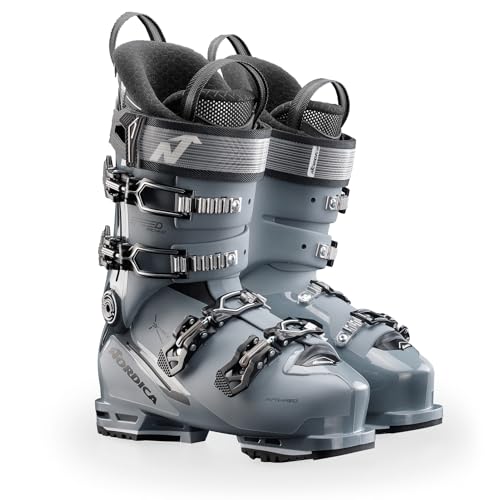
The Speedmachine 3 100 is the step up for an intermediate who has outgrown a soft beginner boot and wants a boot that answers back. Its 100mm medium last holds the foot firmly without pinching, the 100 flex is stiff enough to carve with confidence on hard snow, and the Tri-Force shell construction puts material where power transfer needs it. GripWalk soles come fitted, the boot is water resistant, and the fit is precise enough for a skier who is starting to ski faster and steeper terrain.
Specs
- 100 flex with a 100mm medium last
- Tri-Force shell construction
- GripWalk soles fitted
- Water resistant
- Anthracite, Black, and White colorway
- Intermediate ability level, all-mountain use
Best for: Progressing intermediates who want a precise 100-flex boot for carving groomers.
Watch out for: This ASIN covers size 25.5 only, so confirm your Mondopoint size before ordering. The 100mm last is a true medium fit, and wide feet will feel it across the forefoot.
Tecnica Mach1 MV 120
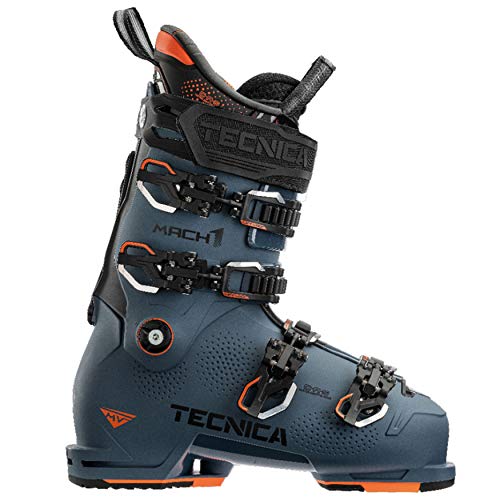
The Mach1 MV 120 is the expert boot for an advanced skier with a medium-volume foot who wants power without a race fit. Its 120 flex is stiff and progressive, the 100mm last holds the foot close for precise edge control, and the C.A.S. shell and liner can be shaped and ground by a fitter for a truly personal fit. The T-Drive spine links the cuff to the shell so the flex stays consistent through the turn, and four micro-adjustable aluminum buckles with a 45mm power strap lock everything down.
Specs
- 120 flex with a 100mm medium-volume last
- C.A.S. shell and liner, customizable by a boot fitter
- T-Drive spine connecting cuff and shell
- Four micro-adjustable aluminum buckles with Lift Lock
- 45mm Velcro power strap
- GripWalk soles on current versions
Best for: Advanced and expert skiers who want a stiff, powerful all-mountain boot.
Watch out for: This ASIN is an older listing, so confirm the model year and the sole type on the listing before you buy — some versions shipped with alpine DIN soles and GripWalk soles sold separately. The 120 flex is genuinely stiff, and an intermediate will find it hard to bend.
Which One Fits Your Situation
Buying Your First Pair After Rentals
If you are buying your first pair after years of rentals, pick the Nordica The Cruise or the Rossignol Evo 70. Both are soft, wide, and easy to get on, and both forgive the mistakes a new skier still makes. The Cruise opens wider at the instep and offers more adjustment, while the Evo 70 is the simpler, lighter-feeling option. Either one beats another season of rental boots that never quite fit.
Wide Feet That Always Hurt by Lunch
If your feet go numb or ache by midday in most boots, pick the K2 BFC 100. Its 103mm last is the roomiest here, the instep and calf volume are built for larger feet, and the heat-moldable shell can be shaped where it still pinches. The Evo 70 and the Cruise are also wide, but the BFC 100 pairs that width with a 100 flex that will not hold back a skier who is improving.
You Ski Faster Now and Want More Support
If you ski faster than you used to and your beginner boots feel vague, pick the Nordica Speedmachine 3 100. Its 100mm last and 100 flex give you edge hold and feedback that a soft boot cannot, without jumping to a race-stiff shell. It is the boot for an intermediate who carves groomers with intent and wants a boot that keeps up.
Advanced Skiers Who Drive the Ski Hard
If you are an advanced skier who drives the ski hard on steep, firm snow, pick the Tecnica Mach1 MV 120. Its 120 flex and close 100mm last deliver the power and precision that softer boots cannot, and the C.A.S. shell gives a fitter plenty to work with. Just be honest about your ability first, because this boot will not bend for a skier who is not ready for it.
Common Mistakes
- Buying your street shoe size instead of measuring your foot in Mondopoint.
- Choosing a stiff flex to match your ambition instead of your ability.
- Ignoring last width and blaming the brand when a narrow boot hurts a wide foot.
- Assuming any boot fits any binding without checking GripWalk against alpine DIN soles.
- Ordering without trying the boot on, and forgetting that one ASIN usually covers one size only.
Frequently Asked Questions
What Mondopoint size should I order?
Measure both feet in centimeters while standing, then order the size that matches the longer foot. Mondopoint is the length of your foot, not your shoe size, and 26.0 and 26.5 usually share the same shell. A new boot should feel snug, since the liner packs out with wear, but your toes should not be crushed against the front.
What flex do beginners need?
Beginners need a soft flex, usually 60 to 80, because a soft shell bends easily and forgives mistakes while you learn. A boot that is too stiff will throw you off balance and make turning harder, not easier. Move up to a 90 or 100 flex only when you can carve confidently and feel your current boots folding under you.
Can I heat-mold these liners at home?
Some liners and shells can be heat-molded, but the job works best when a ski shop does it with the right oven and fitting tools. Home attempts with a hair dryer can damage the liner or warp the shell. Ask the shop to mold the boot after you buy it, and wear the socks you ski in during the fitting.
Will GripWalk soles fit my bindings?
GripWalk soles fit most modern bindings that are marked GripWalk compatible, including many current alpine bindings. They do not fit older bindings that only accept flat alpine DIN soles, and they do not fit pin or touring bindings. Check the binding maker’s compatibility list and the sole norm printed on your boot before you buy.
FAQ
What Mondopoint size should I order?
What flex do beginners need?
Can I heat-mold these liners at home?
Will GripWalk soles fit my bindings?
More from Amazon
Programs that pair well with the guide above. Offers and eligibility are set by Amazon and may change.
Free shipping on eligible items, Prime Video and more. Eligible new members can start with a free trial.
Start a Prime free trialAudiobooks and podcasts to listen to on the go. Eligible new members can start with a free trial.
Try Audible freeAd-free music streaming. Eligible new subscribers can start with a free trial.
Try Music Unlimited freeA free business account with business pricing and bulk-buying tools for work, shop or home office.
Create a business accountAs an Amazon Associate we earn from qualifying purchases.

Write Your Review
No reviews yet. Be the first to share your experience!