
Key takeaways
- Compare the best firewood moisture meters, from pin meters with a 5 to 50 percent wood range to pinless scanners, with accuracy, depth and battery advice.
A woodpile that looks ready can burn badly. The outside of a split dries first, so a light, hollow-sounding piece can still hold wet wood in the middle, and wet wood smoulders, smokes and coats the flue with creosote instead of giving heat. A moisture meter settles the question with a number: the EPA says wood burns best below 20 percent moisture, and a reading against that line tells you whether a split goes in the stove or back on the stack for another season.
This guide is for homeowners who heat with a stove or fireplace, for buyers who season their wood and for anyone who buys cords from a supplier and wants to check the load before it is stacked. The five meters below were picked from names and specs printed on Amazon listings, covering pin meters, pinless scanners and two tools that do both, so you can match the sensing method, the wood range and the reading depth to the pile you burn.
Quick Picks
As an Amazon Associate we earn from qualifying purchases.
| Product | Best for | Key spec from title |
|---|---|---|
| General Tools MMD4E | A first pin meter for one woodpile | Pin meter, 5 to 50 percent wood range |
| Dr.meter MT1905 | Pin and pinless sensing in one tool | Pin 5 to 50 percent, pinless 0 to 53 percent |
| Klein Tools ET140 | Scanning walls and wood without holes | Pinless, reads up to 3/4 inch deep |
| General Tools MMD950 | Deep scans plus a remote pin probe | Pinless ball sensor, up to 4 inches deep |
| General Tools MMD7NP | Quick pinless checks across a stack | Pinless, softwood 0 to 53 percent |
How to Choose
Pin or Pinless: What the Sensor Actually Reads
A pin meter pushes two steel pins into the wood and reads the resistance between them, so it measures the wood the pins touch. A pinless meter lays a flat sensor or a ball against the surface and reads the change in an electric field, so it averages the moisture from the surface down to its stated depth. Neither method reads the whole split. Pins leave two small holes and suit a bare split face, while a pinless sensor leaves no mark and suits finished wood, walls and floors. For firewood alone, pins give the more direct number; for damp patches in a house, pinless earns its place.
Range and Accuracy: Reading the Numbers the Listing Prints
Every meter in this guide prints a wood range, and some print an accuracy figure while others do not. A range of 5 to 50 percent covers the firewood question, because the decision line sits at 20 percent and green wood can read far above it. A meter that tops out at 35 percent for hardwood still answers the burn-or-wait question. Accuracy matters near the line: on a meter rated at plus or minus 2 percent, a reading of 19 percent could mean anywhere from 17 to 21. Treat any reading within two points of 20 as borderline and give the pile more time.
Depth: How Far Into the Wood the Reading Reaches
Depth decides whether a reading describes the surface or the core. Pin meters in this guide reach 8 to 10 millimetres, about a third of an inch, so they read the outer layer of a split. Pinless meters reach further: three quarters of an inch on the Klein and the MMD7NP, and four inches on the spherical sensor of the MMD950. Deeper is not always better, because a pinless reading averages everything from the surface down, and a dry shell over a wet core can still fool it. Split a test piece first, then read the fresh face.
Power and Display: Batteries, Alarms and Reading in the Dark
A meter is useless on a cold evening if its battery is dead, so check what powers it and whether the battery comes in the box. The General Tools meters in this guide run on a 9 volt battery, the Dr.meter MT1905 runs on AAA batteries that are not included, and the MMD950 takes a single 9 volt cell. A backlit screen matters when you test a pile after dark, and a three-colour display that turns red above the high band lets you sort splits without reading digits. Audible alarms help too: several meters in this guide beep when wood reads above 17 percent, which is just under the EPA line.
The 5 Best Options
General Tools MMD4E Digital Pin Moisture Meter
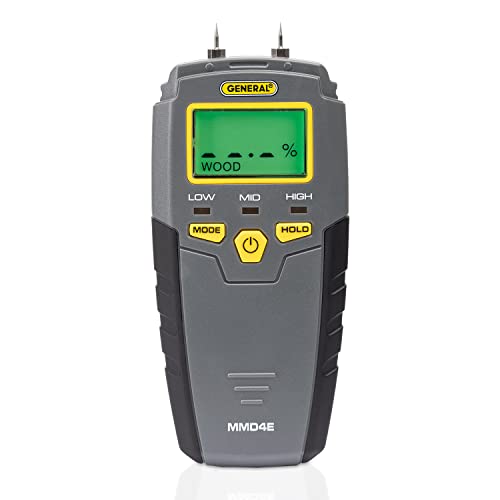
The MMD4E is the straightforward pick for a homeowner who seasons one woodpile and wants a number they can trust. Two stainless steel pins, 8 millimetres long, push into a split face, and a backlit LCD shows the moisture as a percentage, with audible and visual alerts for low, medium and high readings. General Tools lists the wood range as 5 to 50 percent at plus or minus 2 percent, with 0.1 percent resolution, covering kiln-dry stock to freshly cut green wood. A switch picks wood or building materials, a hold button freezes the reading, and the pin cap doubles as a calibration checker.
Specs
- Sensing: pin-type, two stainless steel pins, 8 mm long
- Wood range: 5 to 50 percent WME, accuracy plus or minus 2 percent, 0.1 percent resolution
- Building material range: 1.5 to 33 percent
- Display: backlit LCD with audible and visual high-medium-low alerts
- Power: one 9V battery, included; auto shut-off after 3 minutes
- Included: spare 8 mm stainless steel pins; pin cap doubles as calibration checker
- Replacement pins: General Tools PIN3, sold separately
- Warranty: 1-year limited warranty
- Weight: 3 ounces
Best for: A homeowner checking one woodpile with a simple pin meter.
Watch out for: The pins reach only 8 mm, so a reading on the bark side can look dry while the core is still wet; always test a freshly split face. Replacement pins are sold separately, so order spares before the season starts.
Dr.meter MT1905 2-in-1 Pin and Pinless Moisture Meter
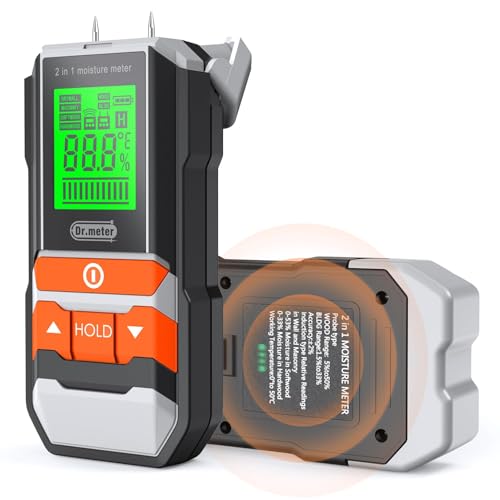
The MT1905 is the pick for a buyer who wants both sensing methods without buying two tools. In pin mode the listing gives wood a 5 to 50 percent range at plus or minus 2 percent, and in pinless mode wood reads 0 to 53 percent at plus or minus 4 percent, with four modes for softwood, hardwood, masonry and drywall. The meter beeps when wood moisture passes 17 percent, just under the EPA line, and it also reads air temperature from 0 to 40 degrees Celsius to within 2 degrees. That combination suits someone who checks a woodpile on Saturday and a suspect wall on Sunday.
Specs
- Sensing: pin-type and pinless in one meter
- Pin mode: wood 5 to 50 percent, accuracy plus or minus 2 percent; building materials 1.5 to 33 percent
- Pinless mode: wood 0 to 53 percent, accuracy plus or minus 4 percent; building materials 0 to 35 percent
- Pinless modes: softwood, hardwood, masonry, drywall
- Alarm: beeps when wood moisture passes 17 percent
- Temperature: 0 to 40 degrees Celsius, accuracy plus or minus 2 degrees
- Power: AAA alkaline batteries, not included
- Weight: 8.47 ounces
Best for: A buyer who wants pin and pinless sensing in a single tool.
Watch out for: The pinless mode carries twice the error of the pin mode, so use the pins for the reading that decides whether a split goes in the stove. AAA batteries are not included, so the meter will not work out of the box without them.
Klein Tools ET140 Pinless Moisture Meter

The ET140 is the pick for a buyer who wants to scan without leaving holes, in wood and around the house. It uses an electromagnetic field to detect relative moisture up to 3/4 inch below the surface, with separate calibrated modes for drywall, masonry, hardwood and softwood. A reverse-contrast display and a nine-bar LED graph show the reading at a glance, and hold, low-battery and auto power-off functions support a round of checks. The body is built to survive a 2 metre drop, which matters for a tool that rides in a coat pocket out to the woodpile.
Specs
- Sensing: pinless, electromagnetic field, non-destructive
- Depth: detects moisture up to 3/4 inch (19 mm) below the surface
- Modes: drywall, masonry, hardwood, softwood
- Display: reverse-contrast display with nine LED bars showing the moisture range
- Drop protection: built to withstand a 2 m (6.6 ft) drop
- Functions: hold, low battery indication, auto power off
- Power: one 9V battery, included
- Included: meter, 9V battery, instruction manual
Best for: Scanning wood, drywall and masonry without leaving pin holes.
Watch out for: The listing describes relative moisture content rather than a true wood percentage, and some roundups cite plus or minus 4 percent on its 0 to 100 reference scale, so confirm what the listing prints before comparing a reading with the EPA 20 percent line. Metal behind a surface, such as corner bead or a nail plate, can give a false wet reading.
General Tools MMD950 Pin and Pinless Moisture Meter

The MMD950 is the pick for a buyer who checks a lot of material and wants the deepest scan in this guide. A spherical ball sensor at the top reads moisture up to 4 inches below a surface without a hole, which suits finished wood, tile and walls, while a remote pin probe on a 46 inch cable gives the precise reading when accuracy matters. The pin mode reads 6.0 to 87.6 percent WME on a 0 to 99.9 count display, accurate within 3 percent of the reading plus 5 digits, and a 40-dot tricolour bar graph groups readings into low, medium and high bands.
Specs
- Sensing: pin-type and pinless in one meter
- Pinless sensor: spherical ball sensor, up to 4 inches (101.6 mm) deep, 1 inch diameter
- Pin probe: remote probe on a 46 inch cable, 10 mm pins, with 10 mm and 15 mm spares
- Pin range: 6.0 to 87.6 percent WME, displayed on a 0 to 99.9 count LCD, 0.1 percent resolution
- Pin accuracy: plus or minus 3 percent of reading plus 5 digits
- Pinless readings: relative only, no accuracy specification
- Display: jumbo LCD with 40-dot tricolour LED bar graph
- Power: one 9V battery; auto power-off adjustable to 3, 5 or 10 minutes
- Weight: 8 ounces
- Included: carrying case
Best for: Deep scans behind walls and under floors plus a remote pin probe for exact readings.
Watch out for: The pinless side gives relative readings only, with no accuracy specification, so use the remote pin probe when the number decides a purchase or a repair. At 8 ounces it is the heaviest meter in this guide, and the 10 mm pins read mostly surface moisture in hard wood.
General Tools MMD7NP Pinless Moisture Meter

The MMD7NP is the pick for a buyer who wants to sweep a whole stack fast without marking a single split. It is a pinless meter with separate settings for drywall, masonry, softwood and hardwood, a 2 inch backlit LCD and a three-colour LED bar graph that turns red when wood reads above the high band. The softwood range runs 0 to 53 percent and the hardwood range 0 to 35 percent, both at plus or minus 4 percent, with a maximum sensing depth of 3/4 inch.
Specs
- Sensing: pinless, non-invasive, non-marring
- Maximum sensing depth: 3/4 inch (20 mm)
- Range: 0 to 53 percent for softwood, 0 to 35 percent for hardwood; relative readings for drywall and masonry
- Accuracy: plus or minus 4 percent on wood, 1 percent resolution
- Display: 2 inch diagonal backlit LCD with three 0.5 inch digits, plus a 3-colour LED bar graph
- Alarm: audible out-of-range alarm when wood reads above the high band
- Power: one 9V battery, included
- Auto power off: after 2 minutes of inactivity
- Weight: 5.4 ounces without battery
- Dimensions: 6.7 x 2.9 x 1.2 inches
Best for: Fast pinless sweeps across a whole woodpile.
Watch out for: The hardwood range tops out at 35 percent, narrower than the 53 percent softwood range, so a very wet hardwood split reads at the ceiling rather than as a number. Copies of the listing quote the wood alarm at 17 percent in some places and 18 percent in others, so treat the alarm as a warning band, not a precise line.
Which One Fits Your Situation
If You Season One Woodpile for Your Own Stove
Pick the General Tools MMD4E. Its pin reading is direct, its 5 to 50 percent wood range covers the whole seasoning curve, and its plus or minus 2 percent accuracy is the tightest pin figure in this guide. The spare pins and the calibration-check cap keep it working through the season, and the 9 volt battery comes in the box. Split a test piece, push the pins into the fresh face, and burn only what reads below 20 percent.
If You Burn Mixed Species From Different Suppliers
Pick the Dr.meter MT1905. Its four pinless modes separate softwood from hardwood, and its pin mode gives a 5 to 50 percent wood range at plus or minus 2 percent for the reading that decides a split. The beep above 17 percent warns you before a load crosses the EPA line. Remember that the pinless mode carries twice the error of the pin mode, so confirm any borderline split with the pins.
If You Also Check Walls and Floors for Leaks
Pick the Klein Tools ET140 or the General Tools MMD950. The ET140 scans drywall, masonry and wood to 3/4 inch deep without a hole, which suits a finished wall. The MMD950 goes further, with a ball sensor that reaches 4 inches behind a surface and a remote pin probe for the exact reading. Either way, use the pin probe when a repair decision rests on the number, because pinless readings are relative.
If You Want to Scan a Whole Stack Fast
Pick the General Tools MMD7NP. Its flat sensor sweeps a split face in a second, the three-colour bar graph turns red above the high band, and the alarm lets you sort without staring at digits. Work through the pile, set aside anything that alarms, and confirm the borderline pieces with a pin meter. Its hardwood range tops out at 35 percent, which is enough for the burn-or-wait decision.
Common Mistakes
- Testing the bark side or the end grain instead of a freshly split face, which can read dry while the core is still wet.
- Comparing a pinless relative reading directly with the EPA 20 percent line, which only applies to a true wood moisture percentage.
- Using the wrong wood mode, such as a softwood setting on a hardwood split, which can throw the reading off.
- Taking one reading from one split and judging the whole pile, when pieces from different species and different spots dry at different rates.
- Ignoring a reading within two points of 20 percent, when the meter’s own accuracy means the split could sit on either side of the line.
Frequently Asked Questions
What moisture level should firewood be before burning?
The EPA says wood burns best below 20 percent moisture, and it tells wood burners to test wood with a meter before burning it. Wood above 20 percent smoulders, gives less heat and coats the flue with creosote. Season softwood at least six months and hardwood at least a year, then test a fresh split face and burn only what reads below 20 percent.
Should I test the bark side or the split face?
Test the split face: pull a piece from the middle of the stack, split it so the inside is exposed, and press the pins or sensor into that fresh face. The bark side dries first and can read dry while the core still holds water. A pin meter reaches only 8 to 10 millimetres, so a reading on the bark side describes the shell, not the split.
Why do two meters give different readings on the same split?
Different meters read different things. A pin meter measures the wood between its two pins, while a pinless meter averages the moisture from the surface down to its stated depth. The wood mode matters too: a softwood setting on a hardwood split can shift the number. Test the same fresh face with both meters, in the right mode, and the readings should sit close together.
Do pinless meters work on firewood?
Yes, with limits. A pinless meter sweeps a split face fast and leaves no holes, which suits sorting a whole stack. Its reading averages the outer layer down to its depth, so a dry shell over a wet core can still fool it. For the reading that decides whether a split goes in the stove, split a test piece and confirm it with a pin meter.
FAQ
What moisture level should firewood be before burning?
Should I test the bark side or the split face?
Why do two meters give different readings on the same split?
Do pinless meters work on firewood?
More from Amazon
Programs that pair well with the guide above. Offers and eligibility are set by Amazon and may change.
Free shipping on eligible items, Prime Video and more. Eligible new members can start with a free trial.
Start a Prime free trialAudiobooks and podcasts to listen to on the go. Eligible new members can start with a free trial.
Try Audible freeAd-free music streaming. Eligible new subscribers can start with a free trial.
Try Music Unlimited freeA free business account with business pricing and bulk-buying tools for work, shop or home office.
Create a business accountAs an Amazon Associate we earn from qualifying purchases.





Write Your Review
No reviews yet. Be the first to share your experience!