
Key takeaways
- Find the best resistance bands for skiers, from mini loops for glute activation to long pull-up bands and tube sets, built for dryland training.
Skiing asks your legs to do two contradictory things at once: hold a deep, steady edge through a long turn, then absorb a sudden bump without collapsing. The real decision is which band format trains the muscles skiing actually uses — the glutes that keep your knees tracking, the quads that control each turn, and the hips that absorb uneven snow. A mini loop that fires up your glutes before the first lift does a different job than a long loop that assists a pull-up, and buying the wrong format is how a set ends up unused in a drawer.
This guide is for skiers building a pre-season dryland routine, riders returning from a knee injury who need graded resistance, and travellers packing light for a ski trip. The five products below were chosen from the names and specifications on their Amazon listings, covering mini loops, flat therapy bands, handled tube sets, long pull-up loops, and fabric hip bands.
Quick Picks
As an Amazon Associate we earn from qualifying purchases.
| Product | Best for | Key spec from title |
|---|---|---|
| Fit Simplify Resistance Loop Exercise Bands, Set of 5 | Glute warm-ups before the first run | 5 latex loops, 12 x 2 inches |
| TheraBand Resistance Bands Set, Beginner Kit | Graded rehab work after a knee injury | 3 flat latex bands, 5 feet each |
| WHATAFIT Resistance Bands with Handles | A full home dryland gym in one bag | 5 tubes, 10 to 50 lb, stack to 150 lb |
| Serious Steel Fitness 41″ Assisted Pull-Up Band Set | Heavy pull-up assistance and barbell work | 6 long loop bands, 41 inches |
| Renoj Resistance Bands for Working Out, 3-Set | Non-slip glute work that stays put | 3 fabric loops, 20 to 70 lb |
How to Choose
Match the band format to the movement
Resistance bands come in four shapes, and each shape suits different ski training. Mini loops wrap around your thighs or ankles for lateral walks, clamshells, and monster walks that wake up the glute medius. Long loops hang from a pull-up bar for assisted pull-ups or anchor low for squats and deadlift variations. Flat bands are the physical therapy standard for controlled shoulder and knee rehab. Tube bands with handles mimic cable-machine presses, rows, and rotations. Before buying, list the five movements you will actually do three times a week, then pick the format that covers most of them.
Read the resistance numbers the right way
A band’s pound figure is measured at full stretch, not at rest, so two bands with the same number can feel different in use. Mini loop sets usually span a wide ladder, such as extra light to extra heavy across five bands, which lets you progress a single movement over a season. Tube sets list each tube separately and let you stack them, so five tubes can combine into far more total resistance than any single tube. Long loop bands are sold by width and thickness, and a wider band assists more. Compare numbers only within one format, and check whether the listing states the figure at a specific stretch.
Latex, fabric, or latex-free
Natural latex snaps back sharply and gives the most consistent tension curve, which is why most loop and tube sets use it, but it is the wrong choice if anyone in the household has a latex allergy. Fabric loops grip skin and leggings, so they stay in place during lateral walks and do not roll up mid-set, though they stretch less than latex and feel different under load. Latex-free flat bands use synthetic rubber and are the standard pick for clinics and allergy-sensitive households. Check the material line on the listing before ordering, and store latex bands away from heat and sunlight, which age the rubber.
Check length, width, and what comes in the box
A 12-inch mini loop fits around thighs and ankles but is too short for most standing presses, while a 41-inch long loop works for pull-up assistance and stretching yet is awkward for glute walks. Tube sets live or die by their accessories: handles, ankle straps, and a door anchor turn five tubes into a portable gym, while a set without an anchor limits you to moves you can hold or step on. A carry bag matters, because bands in a bag by the door get used, and bands buried in a closet do not. Confirm the included parts on the listing.
The 5 Best Options
Fit Simplify Resistance Loop Exercise Bands, Set of 5

This five-band set is the simplest starting point for ski-specific glute work. The loops are short enough to sit just above the knees for lateral walks and clamshells, and the five graded levels mean a skier can warm up light on the first set and finish heavy without swapping equipment. The included carry bag and illustrated instruction guide make it easy to take the whole set to a condo or a lodge room, and the latex construction keeps tension consistent through a full season of pre-season training.
Specs
- Five latex loop bands in five color-coded resistance levels
- Each band measures 12 x 2 inches
- Resistance levels from extra light at 2 to 4 lb up to extra heavy at 25 to 30 lb
- Includes a portable carry bag and an illustrated instruction guide
- Item weight: 3.5 ounces for the set
- Model number: XCEX-01
Best for: Skiers who want a quick glute activation routine before skiing or a compact warm-up set for travel.
Watch out for: The loops are short, so most standing upper-body presses feel awkward; check that your planned movements fit a 12-inch loop before buying.
TheraBand Resistance Bands Set, Beginner Kit

TheraBand’s beginner kit is the flat-band option, and it earns its place through graded, predictable resistance rather than variety. Three bands in yellow, red, and green give a clear progression for knee rehab and shoulder stability work, which matters for skiers rebuilding strength after an injury or working on the small stabilisers that keep knees aligned in a turn. Because the bands are flat sheets rather than loops, they wrap easily around a foot or a post, and they fold flat into a jacket pocket for use at the mountain.
Specs
- Three flat latex bands in yellow, red, and green
- Each band is 5 feet long and 5 inches wide
- Beginner set with three graded resistance levels
- Flat sheet format, not a loop or a tube
- Suitable for upper and lower body exercise and physical therapy
Best for: Skiers doing graded rehab or controlled stability work after a knee or shoulder injury.
Watch out for: Flat bands need to be gripped or tied to anchor, so check that you have a comfortable way to hold them during your exercises.
WHATAFIT Resistance Bands with Handles

WHATAFIT’s tube set is the closest thing to a portable home gym in this guide. Five color-coded tubes clip onto cushioned handles, ankle straps, or a door anchor, which opens up presses, rows, rotations, and leg work that loop bands cannot do well. The tubes stack, so a skier can start with one light tube for warm-ups and combine several for heavy rows or squats as pre-season strength builds. For a skier training at home without a rack or dumbbells, this is the set that covers the most movements in one bag.
Specs
- Five natural latex tubes rated at 10, 20, 30, 40, and 50 lb
- Tubes combine for up to 150 lb of total resistance
- Each tube is 48 inches long with dual-layer latex construction
- Includes two cushioned handles, two ankle straps, a door anchor, a carry bag, and an exercise guide
- Model number: AMZ-RB11
- 2-year limited warranty
Best for: Skiers building a full dryland strength routine at home with presses, rows, and leg work.
Watch out for: The tubes are latex, so confirm no one using them has a latex allergy, and inspect the connection points before each session.
Serious Steel Fitness 41″ Assisted Pull-Up Band Set
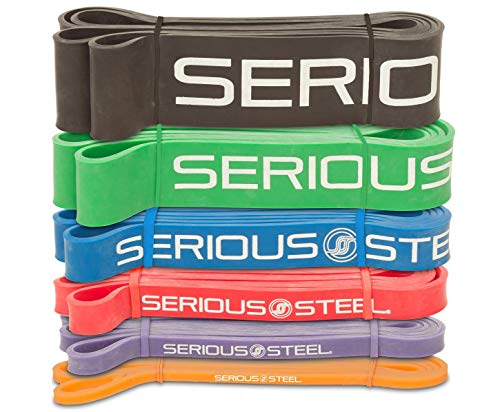
Serious Steel’s six-band set is built around long loops, and that length is what makes it useful for skiers. A 41-inch loop assists pull-ups, stretches tight hip flexors after a day on snow, and adds resistance to barbell squats and deadlifts for lifters who train with a bar. Six bands numbered zero through five give a long progression ladder, from light assistance for mobility work to heavy assistance for pull-up training, and the layered latex construction is made to survive repeated stretching under load.
Specs
- Complete set of six long loop bands, numbered 0 through 5
- Each band is 41 inches long
- Part number: SBSS
- The number 2 red band measures 13/16 inch wide and 4.5 mm thick, with 10 to 50 lb of resistance
- Designed for assisted pull-ups, stretching, powerlifting, and resistance training
Best for: Skiers who train with a pull-up bar or a barbell and want a long progression from light to heavy assistance.
Watch out for: A single heavy band assists less than many buyers expect, so check the width and thickness of the band you need rather than assuming the set’s heaviest band will do the job alone.
Renoj Resistance Bands for Working Out, 3-Set

Renoj’s fabric loops solve the one problem latex mini loops have on ski legs: they stay put. The woven fabric grips leggings and skin, so the band does not roll up during lateral walks or slide down during squats, which keeps tension on the glutes instead of on your patience. Three levels from light to heavy cover warm-ups through serious glute training, and the set includes a storage bag and a training guide, making it a tidy option for skiers who want one set for lower-body work and nothing else to manage.
Specs
- Three fabric loop bands: light at 20 to 35 lb, medium at 30 to 50 lb, and heavy at 45 to 70 lb
- Non-slip fabric construction designed to stay in place during exercise
- Includes a storage bag and a training guide manual
- Suitable for glute activation, Pilates, yoga, and leg training
Best for: Skiers whose latex loops roll or slip during lateral walks and squats.
Watch out for: Fabric bands stretch less than latex, so the feel at full stretch is firmer; confirm the lightest band is light enough for your warm-up sets.
Which One Fits Your Situation
Building a pre-season leg routine at home
Pick the WHATAFIT tube set. The handles and door anchor turn five tubes into presses, rows, and rotations, and stacking the tubes lets you progress from light warm-ups to heavy work across a whole pre-season. Add the Fit Simplify loops for glute activation, and you have a complete home routine without a rack.
Warming up glutes before the first run
Pick the Fit Simplify loop set or the Renoj fabric set. Both sit above the knees for lateral walks and clamshells, and both fit in a jacket pocket or a boot bag. Choose Renoj if your latex loops keep rolling down mid-set, and Fit Simplify if you want five graded levels in the lightest package.
Rebuilding strength after a knee injury
Pick the TheraBand beginner kit. Three flat bands in yellow, red, and green give a clear, gentle progression, and the flat format wraps easily around a foot or a post for controlled knee and hip work. Move up one color only when the current band stops challenging the movement.
Packing light for a ski trip
Pick the Fit Simplify loop set. Five bands, a carry bag, and a guide weigh 3.5 ounces in total, which is lighter than a single water bottle. The set covers glute activation, mobility, and light strength work in a lodge room, and it takes up no meaningful space in a ski bag.
Common Mistakes
- Buying one heavy band and expecting it to cover warm-ups, strength work, and rehab; a set with graded levels is what makes progression possible.
- Choosing tube bands for lateral walks and clamshells, where a short loop around the thighs does the job far better.
- Ignoring latex allergies in the household and ordering a latex set without checking the material line on the listing.
- Stretching a band past its intended length or anchoring it to a sharp edge, which shortens its life and risks a snap.
- Skipping the anchor check: a door anchor on the wrong side of the door or a handle clipped loosely can fail mid-rep, so test the setup with light tension first.
Frequently Asked Questions
Do resistance bands actually help skiing?
Yes, when the movements match the sport. Bands train the glutes, hips, and quads that control each turn and absorb uneven snow, and they build the eccentric strength that keeps knees stable through long runs. They work best as part of a routine with lateral walks, squats, and single-leg work, done consistently through the pre-season rather than in one burst before a trip.
Which band format is best for knee stability?
Mini loops and flat bands do the most for knee stability. Mini loops around the thighs load the glute medius during lateral walks and clamshells, which keeps knees tracking over the toes. Flat bands give graded resistance for controlled rehab and single-leg balance work. Long loops and tubes are better for general strength than for the small stabilising muscles around the knee.
How often should skiers use bands in pre-season?
Three short sessions a week is a practical target, each lasting 20 to 30 minutes and covering glutes, quads, hips, and core. Consistency matters more than length: a short routine done three times a week for eight weeks builds more usable strength than a long session done once. Keep one light band in your ski bag for warm-ups.
Can bands replace weights for ski training?
Bands can replace weights for much of a ski conditioning routine, especially glute activation, mobility, and single-leg stability work, but they are not a perfect substitute for heavy squats and deadlifts. A band’s tension increases as it stretches, which differs from a barbell. Many skiers use bands for accessory and warm-up work and keep heavy barbell lifts for maximal strength.
FAQ
Do resistance bands actually help skiing?
Which band format is best for knee stability?
How often should skiers use bands in pre-season?
Can bands replace weights for ski training?
More from Amazon
Programs that pair well with the guide above. Offers and eligibility are set by Amazon and may change.
Free shipping on eligible items, Prime Video and more. Eligible new members can start with a free trial.
Start a Prime free trialAudiobooks and podcasts to listen to on the go. Eligible new members can start with a free trial.
Try Audible freeAd-free music streaming. Eligible new subscribers can start with a free trial.
Try Music Unlimited freeA free business account with business pricing and bulk-buying tools for work, shop or home office.
Create a business accountAs an Amazon Associate we earn from qualifying purchases.



Write Your Review
No reviews yet. Be the first to share your experience!