
Key takeaways
- Find the best spotting scopes for winter wildlife and birds, with guidance on magnification, objective size, angled bodies and tripods for cold days.
Winter changes what you can see outdoors. Waterfowl gather on open water that has not yet frozen, raptors perch along field edges in bare trees, and feeder birds crowd close to houses through the short daylight hours. A spotting scope brings those distant subjects close enough to study plumage, markings, and behavior without walking out and flushing the whole flock.
This guide compares five scopes suited to watching from a cabin window, a shoreline, or a trail overlook in cold weather. It covers magnification, objective size, body shape, and tripod support, using only details drawn from the product listings.
As an Amazon Associate, we earn from qualifying purchases.
Quick answer
For most winter watchers, an angled scope in the 20-60x range with an 80mm objective on a firm tripod gives the clearest view of distant waterfowl and raptors in flat winter light. Choose a 65mm model if you carry your gear on foot, and look for sealed, nitrogen filled bodies that resist internal fogging when moving between warm rooms and cold air.
How to choose
Magnification is the first number to weigh. Lower power, around 16x to 20x, gives a wider field of view that makes it easier to find a bird and follow it as it moves. Higher power, up to 48x or 60x, helps with feather detail and distant perched raptors, but it also magnifies shake, so it needs solid support to stay useful.
Objective size is the second number. A larger front lens, such as 80mm, gathers more light and helps at dawn and dusk, when winter wildlife is often most active. A 65mm objective gathers less light but keeps the scope shorter and lighter, which matters on a snowy trail.
Body shape affects comfort more than image quality. An angled body, with the eyepiece set at 45 degrees, lets several people of different heights share one scope on one tripod height, and it works well when looking upward at birds in trees. A straight body lines up naturally with a subject at eye level.
Tripod choice decides how much of the zoom range you can use. At 40x and above, even a small wobble blurs fine detail, so a full height tripod with a smooth head is worth carrying for shoreline work. Compact tabletop tripods included with some scopes suit a cabin windowsill, but they limit height and stability outdoors in wind.
Cold weather adds two more checks. Sealed bodies filled with nitrogen resist internal fogging when a scope moves from a warm cabin into freezing air, and rubber armor gives a surer grip with gloves on. Large focus wheels are easier to turn with mittens, and a dual focus system helps with small adjustments on a distant bird.
Vortex Diamondback HD 16-48×65 Angled Spotting Scope

The Diamondback HD in this size pairs a 16-48x zoom with a 65mm objective, a pairing that favors carrying over maximum reach. The lower end of the zoom gives a wide field for scanning a lake edge, while the 48x top end is enough for perched raptors and waterfowl at moderate range. For winter walkers, this is the most portable full scope in this group.
Listing details point to high density extra-low dispersion glass with fully multi-coated lenses, linked to strong color fidelity across the zoom range. The angled body keeps viewing comfortable seated or standing, and the listed eye relief should suit many glasses wearers.
Specs
- Magnification: 16-48x zoom
- Objective lens diameter: 65mm
- Body style: Angled, eyepiece set at 45 degrees
- Field of view: 138 to 72 feet at 1000 yards
- Eye relief: 20.3 to 18.3mm
- Close focus: 16.4 feet
- Length: 14.25 inches
- Weight: 49.8 ounces
- Glass: High density extra-low dispersion elements, fully multi-coated
Celestron Ultima 80 20-60×80 Angled Spotting Scope

The Ultima 80 is a long running refractor design built around a 20-60x zoom eyepiece and an 80mm objective. That larger front lens is the main draw for winter use, since it supports brighter views in dim morning and afternoon light, when ducks, geese, and owls are often on the move. The angled body suits shared viewing at a shoreline or overlook.
The listing describes multi-coated optics with BaK4 prism glass, a waterproof body filled with dry nitrogen to limit internal fogging, and a large focus dial that should be manageable with gloves. A soft case is included, and the eyepiece carries an integrated T-adapter for attaching a camera body with a suitable ring.
Specs
- Magnification: 20-60x zoom
- Objective lens diameter: 80mm
- Body style: Angled, 45 degree viewing angle
- Field of view: 105 to 53 feet at 1000 yards
- Eye relief: 18mm
- Close focus: 26.2 feet
- Weight: 3.56 pounds
- Prism: BaK4
- Protection: Waterproof and fogproof, nitrogen filled
- Included: Soft carrying case, zoom eyepiece with T-adapter
Athlon Talos 20-60×80 Angled Spotting Scope
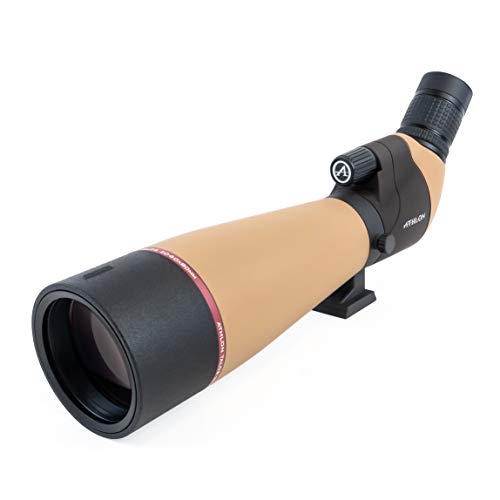
The Talos offers the familiar 20-60x and 80mm pairing in a lighter composite chassis than most scopes of this size. At a listed 38.5 ounces, it asks less of the tripod and of the person carrying it, which helps on winter paths. The angled eyepiece suits group viewing at a frozen lake edge or a hawk watch platform.
According to the listing evidence, the lenses are fully multi-coated and the prisms use K9 glass with a silver coating. The body is sealed, waterproof, and nitrogen purged, with a twist up eyecup and a rotating ring. A tabletop tripod and a soft case are listed as included, though a taller tripod will serve better outdoors.
Specs
- Magnification: 20-60x zoom
- Objective lens diameter: 80mm
- Body style: Angled, eyepiece at 45 degrees
- Field of view: 82.9 to 48 feet at 1000 yards
- Eye relief: 17.5 to 15mm
- Close focus: 19.7 feet
- Weight: 38.5 ounces
- Prism: K9 glass with silver coating
- Protection: Waterproof, nitrogen purged, fogproof
- Included: Tabletop tripod and soft case
Gosky 20-60×80 Spotting Scope with Tripod and Phone Holder

This Gosky kit is built for watchers who want everything in one box. Along with the scope itself, the listing includes a full metal tabletop tripod, a carrying bag, and a quick phone holder, so a cabin table can become a viewing spot within minutes. The phone holder also lets a whole group watch feeder birds on one screen.
The scope uses an 80mm fully multi-coated objective and a BaK4 Porro prism. The body is nitrogen filled and sealed for waterproof and fogproof use, with rubber armor for grip. The phone adapter is listed as fitting phones from 54 to 90mm wide and up to 14mm thick, and the scope mounts on any tripod with a standard quarter inch screw fitting.
Specs
- Magnification: 20-60x zoom
- Objective lens diameter: 80mm
- Body style: Angled
- Field of view: 82.9 to 48 feet at 1000 yards
- Prism: BaK4 Porro
- Lens coating: Fully multi-coated
- Protection: Nitrogen filled, waterproof and fogproof, rubber armored body
- Mount: Standard quarter inch tripod thread
- Included: Metal tabletop tripod, phone holder, carrying bag, lens covers, cleaning cloth
SVBONY SV406P 20-60×80 ED Spotting Scope

The SV406P is the pick here for watchers who care most about fine detail at the top of the zoom range. Its extra-low dispersion glass is included to reduce color fringing, the colored edge that can appear around a dark bird against a bright winter sky. A dual focus system, with separate coarse and fine wheels, makes small focus corrections easier at long range.
Listing and manual evidence describe a 20-60x zoom, an 80mm objective, BaK4 Porro prism glass, and fully multi-coated optics. The body carries a strong waterproof grade and nitrogen filling against fogging, and the eyepiece uses a standard 1.25 inch fitting. No tripod is listed as included, so plan on a firm full height model for viewing at 60x.
Specs
- Magnification: 20-60x zoom
- Objective lens diameter: 80mm
- Body style: Angled
- Field of view: 108 to 60 feet at 1000 yards
- Eye relief: 20 to 18mm
- Close focus: 5.5 meters
- Weight: 1625 grams
- Glass: Extra-low dispersion elements
- Prism: BaK4 Porro, fully multi-coated
- Focus: Dual wheels, coarse and fine
- Protection: Waterproof, nitrogen filled
Who should skip
Skip this whole category if you mostly watch birds at close range in your own garden. A scope with a close focus beyond 16 feet will frustrate you at a near feeder, and ordinary binoculars will feel quicker and wider for yard birds and subjects that move fast through brush.
Skip the larger 80mm models if you plan long walks on snow with no vehicle support. Scope, tripod, and winter clothing add up quickly. The 65mm Vortex or a smaller optic you already own will serve you better on foot.
Skip any scope without a tripod plan. Every model here needs support at useful magnification, and hand holding a scope at 40x or 60x will blur the very detail you bought it to see.
FAQ
How much magnification do I need for winter waterfowl?
For ducks and geese on open water, 20x to 40x covers most viewing, since flocks sit far from shore but individual birds are fairly large. The upper end of a 60x zoom helps with distant divers and perched eagles, yet haze and falling snow often limit clarity before magnification runs out.
Is an angled or straight body better for a cabin window?
An angled body usually works better at a window or table, because you look down into the eyepiece while the scope points level or slightly upward, and people of different heights can share it without moving the tripod. A straight body suits a low hide or a vehicle window mount.
Will a spotting scope fog up in cold weather?
Any optic can fog on its outer surfaces when warm moist air meets cold glass, so let the scope cool gradually and keep it in its case during the move outdoors. Sealed, nitrogen filled bodies, like most picks here, resist fogging inside the scope, which is the harder problem to fix in the field.
Can I use one of these scopes for feeder birds?
Yes, if the scope focuses close enough for your setup. Check the close focus figure in the Specs above: a scope that focuses near 16 feet can handle a feeder across a small yard, while one needing 26 feet suits larger properties.
Final verdict
For a single scope to cover a winter of watching, the 80mm models with a 20-60x zoom give the most range, and the Celestron Ultima 80 and Athlon Talos both deliver that pairing with sealed, fog resistant bodies. The Talos is the lighter carry, while the Ultima adds a camera adapter. Choose the Vortex Diamondback HD 65mm if you walk far between overlooks, the Gosky kit if you want a tripod and phone holder included from day one, and the SVBONY SV406P if fine focus control and extra-low dispersion glass matter most. Whichever you pick, pair it with the firmest tripod you are willing to carry, since support decides how clear a winter view will be.
Product and ASIN Reference
| Product | ASIN |
|---|---|
| Vortex Diamondback HD 16-48×65 Angled Spotting Scope | B08DVCLB3W |
| Celestron Ultima 80 20-60×80 Angled Spotting Scope | B0002CTZ70 |
| Athlon Talos 20-60×80 Angled Spotting Scope | B07H75Q748 |
| Gosky 20-60×80 Spotting Scope with Tripod and Phone Holder | B07KFTV8WM |
| SVBONY SV406P 20-60×80 ED Spotting Scope | B0855RBQMR |
FAQ
How much magnification do I need for winter waterfowl?
Is an angled or straight body better for a cabin window?
Will a spotting scope fog up in cold weather?
Can I use one of these scopes for feeder birds?
More from Amazon
Programs that pair well with the guide above. Offers and eligibility are set by Amazon and may change.
Free shipping on eligible items, Prime Video and more. Eligible new members can start with a free trial.
Start a Prime free trialAudiobooks and podcasts to listen to on the go. Eligible new members can start with a free trial.
Try Audible freeAd-free music streaming. Eligible new subscribers can start with a free trial.
Try Music Unlimited freeA free business account with business pricing and bulk-buying tools for work, shop or home office.
Create a business accountAs an Amazon Associate we earn from qualifying purchases.
Write Your Review
No reviews yet. Be the first to share your experience!