
Key takeaways
- Compare the best ski wax irons for home tuning, from a Swix dial iron to a digital TOKO, with plate sizes, wattage and temperature ranges explained.
A wax iron is the tool that turns a block of glide wax into an even, durable layer on a ski base. Unlike a household clothes iron, a dedicated wax iron has no steam holes, holds a narrow temperature band, and uses a thick flat plate that spreads heat evenly from tip to tail. If you already own wax, a scraper and brushes, the iron is the missing piece that makes home tuning calm and repeatable.
This guide compares five standalone wax irons sold on their own, with no wax bundles and no extra tools in the box. The picks span a plain dial iron for occasional use, two models from TOKO, a compact Wintersteiger iron and a dimpled-plate XCMAN iron. Each section sticks to listing facts: wattage, voltage, temperature range, plate size and plate build.
As an Amazon Associate, we earn from qualifying purchases.
Quick answer
For most home tuners, the Swix T77 is the simple pick: 1000 watts, a wide 100 by 160 millimeter plate and a dial covering 80 to 170 degrees Celsius. Choose the TOKO T14 if you want a digital readout and quicker heat recovery. The TOKO T8 covers everyday waxing with a long cord, the XCMAN adds a dimpled plate, and the Wintersteiger is the compact pick for travel.
How to choose
Temperature control comes first. Every glide wax has a melting range printed on its packaging, and the iron has to hold that range without drifting. A simple dial is enough for one or two wax types used all season. A digital control with a live readout suits tuners who swap between warm, universal and cold waxes often, because the display shows the plate temperature as it recovers.
Plate build matters next. A thicker plate stores more heat, so the temperature dips less along a cold ski base. A longer plate covers a ski in fewer passes, while a shorter plate is easier to guide around the curved tip and tail of a snowboard. Grooves or dimples give melted wax a path to spread instead of pooling at the edges.
Wattage links to heat recovery. Higher wattage irons climb back to the set temperature quickly after each pass, which helps when you wax several pairs of skis in one session. Lower wattage irons still melt wax well, but they reward a slower pace. Check the voltage first: the irons in this guide are North American models, and an iron built for one region belongs on that region’s outlets only.
Handling care is simple. Keep the iron moving at a steady pace and never let it sit still on the base. Rest it on its stand or heel between passes, away from wax shavings and paper. Unplug the iron as soon as you finish, let the plate cool fully before the iron goes back into a drawer or bag, and keep the hot tool away from children at all times.
Swix T77 Economy Waxing Iron

The T77 is Swix’s straightforward dial iron for alpine skis, Nordic skis and snowboards. It runs at 1000 watts on 110 volts, and the temperature dial covers 80 to 170 degrees Celsius, a span wide enough for soft warm-weather waxes at the low end and hard cold-snow waxes at the top end. With no digital display, the dial setting and the flow of the wax are your guides.
The plate measures 100 by 160 millimeters, giving broad coverage per pass on wide skis. The listing notes an angled backplate, which helps the iron glide without catching when you pull it toward you. For a home bench, this is the plain layout: one dial, one plate, no menus.
Specs
- Power: 1000 watts
- Voltage: 110 volts
- Temperature range: 80 to 170 degrees Celsius
- Plate size: 100 x 160 millimeters
- Plate build: metal plate with angled back edge
- Control: dial adjustment, no digital display
- Use: alpine skis, Nordic skis and snowboards
TOKO T14 Digital Wax Iron

The T14 is TOKO’s digital step up, built around a microprocessor that regulates plate temperature and shows it on a readout. At 1200 watts, the highest figure in this guide, the plate returns to the set point quickly between passes. The range runs from 100 to 160 degrees Celsius, shown as 212 to 320 degrees Fahrenheit on the listing.
The plate is aluminum pressure cast with a curved rhomboid structure, a pattern meant to spread melted wax and keep contact even as the iron moves. The listing gives a weight of 2.25 pounds and dimensions of 5 by 6 by 10 inches, and the box holds the iron only, one piece. If you wax weekly or tune skis for the whole household, the readout and fast recovery are the reasons to pick this one.
Specs
- Power: 1200 watts
- Voltage: 110 volts
- Temperature range: 100 to 160 degrees Celsius (212 to 320 degrees Fahrenheit)
- Control: digital with microprocessor regulation
- Plate: aluminum pressure cast with curved rhomboid structure
- Weight: 2.25 pounds
- Size: 5 x 6 x 10 inches
- In the box: iron only, one piece
TOKO T8 Hot Wax Iron

The T8 uses the same curved rhomboid plate idea as the T14 in a simpler, dial-controlled iron. It runs at 800 watts on 110 volts, with an adjustable range of 100 to 160 degrees Celsius, or 212 to 320 degrees Fahrenheit. The aluminum pressure cast plate measures 4 by 6 inches and is about half an inch thick, so it carries a useful store of heat for its size.
An 8-foot cord gives you room to work along a full-length bench without moving the outlet strip, and the listed weight of about 2.1 pounds keeps the iron easy to guide with one hand. There is no display, so allow the plate a moment to settle after each adjustment. As a first dedicated iron, or a spare for a travel bag, the T8 covers the core job well.
Specs
- Power: 800 watts
- Voltage: 110 volts
- Temperature range: 100 to 160 degrees Celsius (212 to 320 degrees Fahrenheit)
- Plate: aluminum pressure cast with curved rhomboid structure
- Plate size: 4 x 6 inches, about half an inch thick
- Cord length: 8 feet
- Weight: about 2.1 pounds
Wintersteiger Ski and Snowboard Waxing Iron
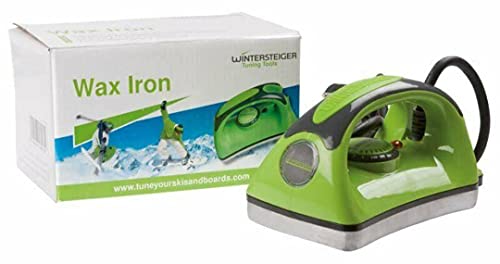
Wintersteiger’s iron is the compact entry in this guide, shaped for tuners who work in small spaces or wax on the road. It runs at 800 watts on 110 volts, and temperature is set with a numbered dial. Summaries of the listing put the range at 100 to 170 degrees Celsius, covering common glide waxes.
The base plate is thick and curved with a smooth finish, a shape that helps the iron ride over the base without digging in at the edges. The handle has an ergonomic form with a rubber grip, and the whole iron weighs about 2 pounds, so it packs easily beside boots and tools. If bench space is tight, or waxing happens in a rental condo more than a garage, this iron is shaped for that life.
Specs
- Power: 800 watts
- Voltage: 110 volts
- Temperature range: 100 to 170 degrees Celsius
- Control: numbered dial
- Plate: thick curved base plate with smooth finish
- Grip: ergonomic handle with rubber grip
- Weight: about 2 pounds
XCMAN Ski and Snowboard Waxing Iron

The XCMAN iron stands out for its dimpled plate. The cast aluminum base carries a pattern of small dimples, and the range runs from 100 to 180 degrees Celsius, the widest span in this guide. That top end gives headroom for hard cold-weather waxes that need more heat to flow. Power is 800 watts at 120 volts, set by a dial rather than a display.
The plate measures 16 by 9 by 1.5 centimeters, or 6.3 by 3.54 by 0.59 inches, and the cord runs 2.4 meters, enough to reach along a bench. The polished plate can fool handheld infrared gauges, so judge the setting by how the wax melts and flows. For tuners who like a textured plate and a broad range, this is a strong fit.
Specs
- Power: 800 watts
- Voltage: 120 volts
- Temperature range: 100 to 180 degrees Celsius
- Plate: cast aluminum with dimpled surface
- Plate size: 16 x 9 x 1.5 centimeters (6.3 x 3.54 x 0.59 inches)
- Cord length: 2.4 meters
- Control: dial adjustment, no digital display
Who should skip
Skip this guide if you own no wax, scraper or brushes yet, because every pick here is the iron alone and you would still need the rest of the bench. Full tuning kits were covered in an earlier guide on this site. Skip it as well if you wax once every few seasons and a local shop handles your skis, since a dedicated iron earns its shelf space only with regular use. Tuners outside North America should look for an iron built for their own voltage rather than adapting one of these 110 or 120 volt models.
FAQ
What temperature should a wax iron be set to?
Follow the melting range printed on your wax packaging, and set the iron inside that range. Most glide waxes melt between 100 and 160 degrees Celsius. If the wax smokes or turns thin and runny, lower the setting and let the plate settle before the next pass.
Can a clothes iron replace a wax iron?
A clothes iron has steam holes that trap wax, a thin plate that swings up and down in temperature, and settings marked for fabric rather than degrees. It can scorch a base or leave wax uneven. A wax iron’s thick, hole-free plate and narrower temperature band exist for exactly those reasons.
How should a wax iron be handled safely?
Keep the iron moving while it touches the base, and rest it on its stand or heel between passes. Unplug it as soon as the session ends, let it cool fully before storing, and keep it away from children. Work on a clear bench so the cord never drags the hot plate toward the edge.
Is a dial or a digital control better for home use?
A dial is simple, sturdy and easy to learn, and it suits one or two wax types used all season. A digital control shows the live plate temperature, which helps when you switch waxes often or wax many skis in a row. Both styles appear in this guide, so choose by how much feedback you want while you work.
Final verdict
Home waxing comes down to steady heat, and each iron here delivers it in a different shape. The Swix T77 is the default pick for most benches: broad plate, wide range, nothing extra to learn. The TOKO T14 adds a digital readout and quick heat recovery for frequent tuners, while the TOKO T8 keeps the same plate family in a simpler form. The Wintersteiger suits small spaces and travel bags, and the XCMAN brings a dimpled plate and the widest temperature span. Match the iron to your wax shelf and your bench, and tuning becomes a quiet routine.
Product and ASIN Reference
| Product | ASIN |
|---|---|
| Swix T77 Economy Waxing Iron | B00MQL875Q |
| TOKO T14 Digital Wax Iron | B0045YL5SS |
| TOKO T8 Hot Wax Iron | B001FEUCTY |
| Wintersteiger Ski and Snowboard Waxing Iron | B0040OBXXU |
| XCMAN Ski and Snowboard Waxing Iron | B0B8X3KL8Y |
FAQ
What temperature should a wax iron be set to?
Can a clothes iron replace a wax iron?
How should a wax iron be handled safely?
Is a dial or a digital control better for home use?
More from Amazon
Programs that pair well with the guide above. Offers and eligibility are set by Amazon and may change.
Free shipping on eligible items, Prime Video and more. Eligible new members can start with a free trial.
Start a Prime free trialAudiobooks and podcasts to listen to on the go. Eligible new members can start with a free trial.
Try Audible freeAd-free music streaming. Eligible new subscribers can start with a free trial.
Try Music Unlimited freeA free business account with business pricing and bulk-buying tools for work, shop or home office.
Create a business accountAs an Amazon Associate we earn from qualifying purchases.

Write Your Review
No reviews yet. Be the first to share your experience!